IBC Totes & Tanks for Sale
Intermediate Bulk Containers are the backbone of modern liquid storage and transport. Rochester IBC carries new, used, and reconditioned totes in every material and size -- ready for pickup or delivery across the Northeast.
Request IBC Tote Pricing
Fill in the details and we'll get back to you within 24 hours.
What Is an IBC Tote?
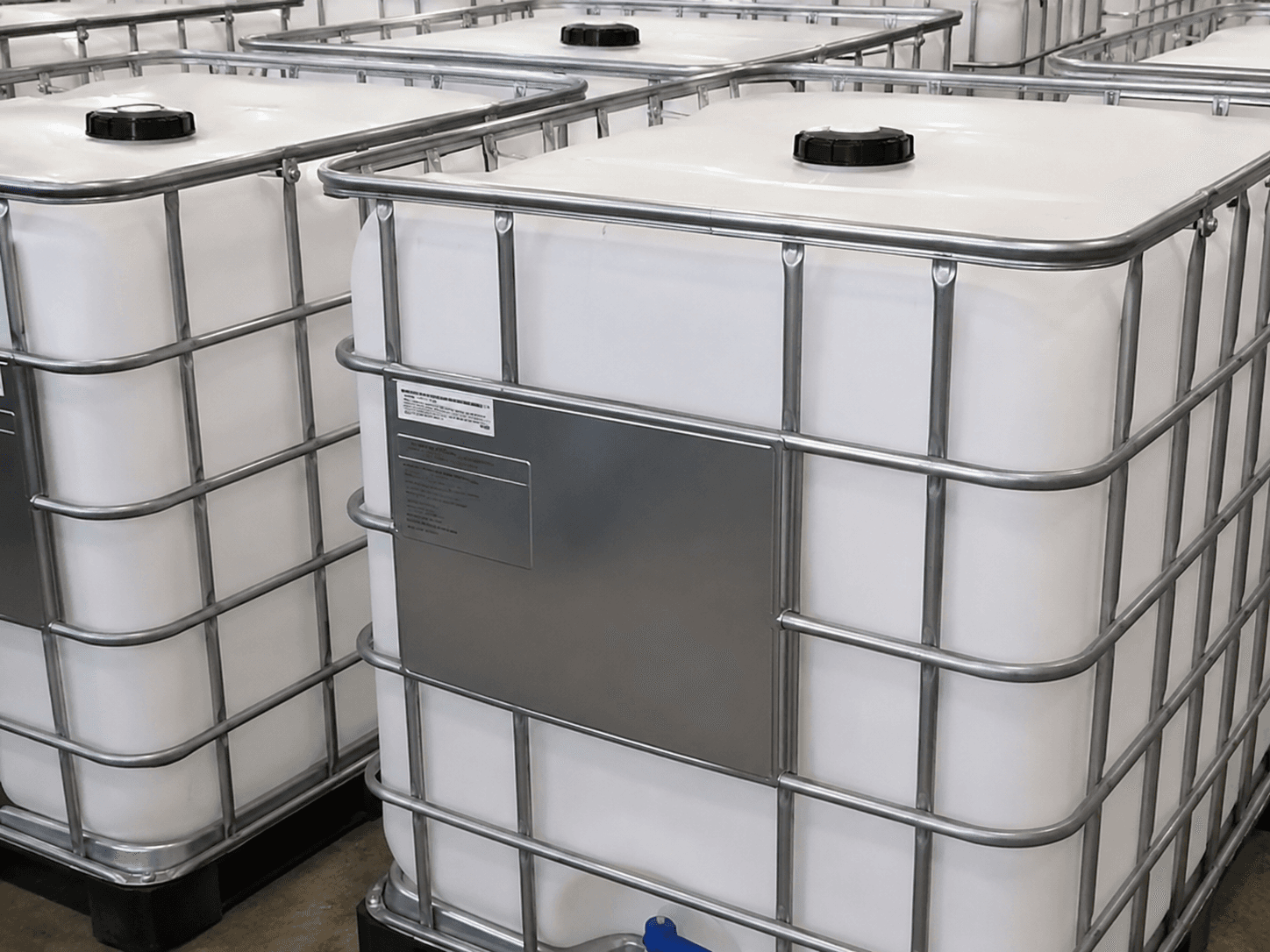
An Intermediate Bulk Container (IBC), also called an IBC tote or IBC tank, is a reusable industrial container designed for the storage and transport of bulk liquids, pastes, and granulated substances. The standard design consists of a rigid or semi-rigid inner vessel surrounded by a protective outer structure mounted on a pallet base. IBCs bridge the gap between drums (55 gallons) and tanker trucks (5,000+ gallons), providing a practical middle ground for businesses that move moderate volumes of liquid.
The IBC was first developed in the 1970s as an alternative to the traditional 55-gallon drum. The key innovation was combining a large-volume inner vessel with a protective cage and integrated pallet, creating a container that could be filled, sealed, moved by forklift, stacked for storage, loaded onto trucks, and delivered to the end user -- all without additional packaging or handling equipment. This single-package convenience revolutionized bulk liquid logistics and rapidly displaced drums in most mid-volume applications.
Today, IBCs are manufactured by companies worldwide and are governed by international standards for construction, testing, and marking. The United Nations system classifies IBCs by type (rigid, flexible, composite), material (metal, plastic, fiberboard), and intended use (hazardous vs. non-hazardous goods). The most common types in North American commerce are rigid composite IBCs (HDPE bottle in a steel cage) and rigid metal IBCs (stainless steel tanks), both of which Rochester IBC stocks in multiple sizes and conditions.
At Rochester IBC, we stock all three major construction types -- polyethylene, composite, and stainless steel -- in multiple sizes and conditions. Every container we sell is inspected, pressure-tested, and ready for immediate use. If you need a specialty configuration, our reconditioning team can often customize a used tote to your exact specifications.
Choose Your IBC Material
Each material type offers distinct advantages. The right choice depends on what you are storing, how you are transporting it, and what regulations apply to your industry.
Poly (HDPE) IBC Totes
High-density polyethylene totes are the most common IBC type on the market. The inner bottle is blow-molded from FDA-accepted HDPE resin, making these containers naturally resistant to a wide range of chemicals, lightweight, and easy to clean. The bottle sits inside a tubular or welded steel cage mounted on a wood, plastic, or steel pallet.
HDPE is a thermoplastic polymer produced from ethylene monomer. In IBC manufacturing, the resin is extruded into a parison and then blow-molded into the bottle shape inside a steel mold. This single-piece construction eliminates seams and joints on the inner bottle, which means there are no weak points where leaks can develop over time. The molecular structure of HDPE gives it excellent impact resistance even at low temperatures, which is why poly totes can operate safely down to -40F without becoming brittle.
The chemical compatibility of HDPE is one of its greatest strengths for general-purpose applications. It resists most aqueous solutions, including acids up to moderate concentrations (sulfuric acid up to 70%, hydrochloric acid up to 37%, nitric acid up to 50%), bases (sodium hydroxide, potassium hydroxide), detergents, alcohols, and most water-based industrial fluids. However, HDPE is not suitable for aromatic solvents (toluene, xylene), chlorinated solvents (methylene chloride, trichloroethylene), or strong oxidizing acids (concentrated nitric, chromic acid). For these chemicals, stainless steel is the appropriate choice.
UV degradation is a consideration for poly totes stored outdoors for extended periods. While most manufacturers add UV stabilizers to the HDPE resin, prolonged exposure to direct sunlight will eventually cause the plastic to become chalky, brittle, and prone to cracking. For outdoor storage exceeding 6 months, we recommend UV-stabilized black or blue bottles, or the use of protective covers. Indoor storage eliminates this concern entirely.
One of the most compelling advantages of poly IBC totes is the rebottling option. When the HDPE bottle reaches the end of its useful life -- typically after 3 to 5 fill cycles depending on the product stored -- the bottle can be removed from the cage and replaced with a brand-new bottle. The steel cage and pallet, which represent a significant portion of the container cost and embodied energy, are reused. This rebottling process extends the overall life of the IBC system to 10-15 years and dramatically reduces waste compared to scrapping the entire unit.
Best For
Water storage, agricultural chemicals, cleaning solutions, food ingredients, industrial fluids, coolants, and non-flammable liquid transport.
Specifications
- Material: High-density polyethylene (HDPE)
- Wall thickness: 2-4 mm
- Temperature range: -40 F to 140 F
- UV stabilized options available
- Typical weight: 120-160 lbs empty
Key Advantages
- Lightweight and easy to handle
- Excellent chemical resistance
- Cost-effective for most applications
- Replaceable inner bottle extends cage life
- Recyclable at end of life
Composite IBC Totes
Composite IBCs combine an inner HDPE bottle with a galvanized steel outer cage and an integrated pallet system. They are the workhorse of bulk liquid transport, designed to be stackable, forklift-compatible, and intermodal-ready. Most composite totes meet UN 31HA1 certification for the transport of hazardous goods when properly rated.
The term "composite" refers to the combination of two distinct materials -- plastic and steel -- working together as an integrated system. The HDPE inner bottle provides chemical containment, while the galvanized steel cage provides structural protection, stacking capability, and compliance with transportation regulations. This dual-material design is what makes composite IBCs the preferred choice for regulated hazardous materials transport, as the steel cage adds a critical layer of physical protection that pure poly totes lack.
UN 31HA1 certification is the key differentiator for composite IBCs in regulated industries. This designation means the container has passed a battery of tests defined by the United Nations Committee of Experts on the Transport of Dangerous Goods, including a drop test (from 1.8 meters onto concrete), a stacking test (equivalent to a load of containers stacked to maximum transport height for 28 days), a hydraulic pressure test (to simulate internal pressure during transport), and a leakproofness test. Not all composite IBCs carry this certification -- it must be specifically requested and verified on the UN marking plate.
The cage construction on composite IBCs typically uses either tubular steel or welded wire mesh, both hot-dip galvanized for corrosion resistance. Tubular cages are stronger and more resistant to forklift impact damage, while wire mesh cages are lighter and allow better visual inspection of the inner bottle. The cage is bolted or welded to the pallet base, creating a rigid structure that can be safely stacked up to 4 units high when full (depending on the specific UN rating and contents).
Composite IBCs are the industry standard in chemical manufacturing, pharmaceutical intermediates, paints and coatings, petroleum products, adhesives, and any application where the container will be transported by truck, rail, or ship and must comply with DOT, IATA, or IMDG regulations. They offer the best balance of cost, weight, chemical compatibility, and regulatory compliance for the widest range of industrial applications.
Best For
Chemical manufacturing, pharmaceutical intermediates, hazardous material transport, paints and coatings, petroleum products, and any application requiring UN certification.
Specifications
- Inner bottle: HDPE, up to 6 mm thick
- Outer cage: Galvanized steel tube or wire mesh
- Pallet: Steel, wood, or composite
- Filling port: 150 mm (6") NW opening
- Discharge valve: 50 mm (2") butterfly or ball valve
Key Advantages
- UN-certified options for hazmat transport
- Superior structural integrity
- Stackable up to 4 high when full
- Compatible with standard pallet racking
- Long service life with proper maintenance
Stainless Steel IBC Totes
Stainless steel IBCs are the premium option for industries that demand absolute purity, extreme temperature tolerance, or compatibility with aggressive solvents that would attack plastic. Constructed entirely from 304 or 316L stainless steel with TIG-welded seams and electropolished interior surfaces, these tanks are built for decades of service.
The choice between 304 and 316L stainless steel depends on the chemical environment. Type 304 (18% chromium, 8% nickel) is the standard grade, suitable for most food, beverage, pharmaceutical, and mild chemical applications. Type 316L (16% chromium, 10% nickel, 2% molybdenum) adds significantly better resistance to chloride-induced pitting and crevice corrosion, making it essential for marine environments, chlorinated solvents, certain pharmaceuticals, and aggressive acid applications. The "L" designation indicates a low-carbon variant that resists sensitization during welding, preventing intergranular corrosion along weld seams.
Interior surface finish is a critical specification for stainless steel IBCs. A 2B mill finish is adequate for industrial chemical storage. A #4 brushed finish provides a smoother surface that is easier to clean and less likely to harbor bacteria. An electropolished finish (Ra less than 0.5 micrometers) is the highest standard, producing a mirror-like surface that resists product adhesion, simplifies CIP (clean-in-place) operations, and meets the stringent requirements of pharmaceutical and biotech applications. The smoother the surface, the easier it is to achieve validated cleaning between product changeovers.
Stainless steel IBCs support cleaning methods that are impossible with plastic containers. They can be steam-sterilized at 250F+ (121C+), CIP-cleaned with caustic and acid wash cycles at elevated temperatures, and even autoclaved in some configurations. This makes them the only viable option for aseptic processing, sterile pharmaceutical manufacturing, and applications where validated cleaning protocols are mandatory. Many stainless IBCs include dedicated CIP spray ball ports, sanitary tri-clamp fittings, and bottom-drain configurations designed specifically for thorough cleaning.
The upfront cost of stainless steel IBCs is significantly higher than HDPE or composite alternatives -- typically $2,000 to $5,000+ new, depending on capacity, grade, and finish. However, the total cost of ownership over the container lifetime often favors stainless steel for high-use applications. A stainless IBC can serve 20+ fill cycles with essentially no degradation in performance, compared to 3-5 cycles for an HDPE bottle. For a pharmaceutical manufacturer filling and cleaning containers weekly, a stainless IBC that lasts 10 years represents a dramatically lower per-use cost than replacing HDPE totes every 6 to 12 months.
Best For
Pharmaceutical manufacturing, cosmetics, high-purity chemicals, food-grade syrups and oils, wine and spirits, flammable solvents, and high-temperature processes.
Specifications
- Material: 304 or 316L stainless steel
- Wall thickness: 1.5-2.0 mm
- Temperature range: -40 F to 400 F
- Surface finish: 2B, #4, or electropolished
- Typical weight: 250-400 lbs empty
Key Advantages
- Virtually unlimited chemical compatibility
- High-temperature and cryogenic rated
- Easy to sterilize and CIP-clean
- No flavor or odor transfer
- Decades of reusable service life
Detailed Specifications by Size
Every dimension, weight, and capacity you need to plan your storage, transport, and racking configurations. All measurements are for standard composite IBC totes; stainless steel and specialty models may vary slightly.
275 Gallon (1,040 Liter) IBC Tote
| Specification | Value |
|---|---|
| Nominal Capacity | 275 US gallons / 1,040 liters |
| Maximum Fill Volume | 270 US gallons (leave headspace for expansion) |
| Overall Dimensions (L x W x H) | 48" x 40" x 46" (1,219 x 1,016 x 1,168 mm) |
| Pallet Footprint | 48" x 40" (standard US pallet) |
| Empty Weight (Poly/Composite) | 120 - 160 lbs (54 - 73 kg) |
| Empty Weight (Stainless) | 250 - 320 lbs (113 - 145 kg) |
| Full Weight (Water) | ~2,440 lbs (1,107 kg) |
| Pallet Type | Steel, wood (HT), or composite -- 4-way forklift entry |
| Discharge Valve | 2" (50 mm) butterfly or ball valve, S60x6 thread |
| Top Opening | 6" (150 mm) screw cap with EPDM/Viton gasket |
| Max Stack Height (Full) | 2 high (poly) / 4 high (composite, depending on UN rating) |
| Wall Thickness (HDPE) | 2.0 - 3.5 mm |
| Cage Material | Galvanized steel tube or wire mesh |
330 Gallon (1,250 Liter) IBC Tote
| Specification | Value |
|---|---|
| Nominal Capacity | 330 US gallons / 1,250 liters |
| Maximum Fill Volume | 325 US gallons (leave headspace for expansion) |
| Overall Dimensions (L x W x H) | 48" x 40" x 53" (1,219 x 1,016 x 1,346 mm) |
| Pallet Footprint | 48" x 40" (standard US pallet) |
| Empty Weight (Poly/Composite) | 130 - 175 lbs (59 - 79 kg) |
| Empty Weight (Stainless) | 275 - 380 lbs (125 - 172 kg) |
| Full Weight (Water) | ~2,910 lbs (1,320 kg) |
| Pallet Type | Steel, wood (HT), or composite -- 4-way forklift entry |
| Discharge Valve | 2" (50 mm) butterfly or ball valve, S60x6 thread |
| Top Opening | 6" (150 mm) screw cap with EPDM/Viton gasket |
| Max Stack Height (Full) | 2 high (poly) / 4 high (composite, depending on UN rating) |
| Wall Thickness (HDPE) | 2.5 - 4.0 mm |
| Cage Material | Galvanized steel tube or wire mesh |
550 Gallon (2,082 Liter) IBC Tote
| Specification | Value |
|---|---|
| Nominal Capacity | 550 US gallons / 2,082 liters |
| Maximum Fill Volume | 540 US gallons (leave headspace for expansion) |
| Overall Dimensions (L x W x H) | 48" x 48" x 55" (1,219 x 1,219 x 1,397 mm) |
| Pallet Footprint | 48" x 48" (oversized -- verify racking compatibility) |
| Empty Weight (Poly/Composite) | 180 - 230 lbs (82 - 104 kg) |
| Empty Weight (Stainless) | 350 - 450 lbs (159 - 204 kg) |
| Full Weight (Water) | ~4,770 lbs (2,163 kg) |
| Pallet Type | Steel or heavy-duty composite -- 4-way forklift entry |
| Discharge Valve | 2" (50 mm) or 3" (75 mm) ball valve |
| Top Opening | 6" (150 mm) or 8" (200 mm) screw cap |
| Max Stack Height (Full) | 2 high maximum (verify with manufacturer) |
| Wall Thickness (HDPE) | 3.0 - 5.0 mm |
| Cage Material | Heavy-duty galvanized steel tube |
Standard IBC Sizes
We stock the three most common IBC capacities. Not sure which size is right? Check our IBC Size Guide for detailed comparisons and use-case recommendations.
The standard US size. Fits a standard pallet footprint and is compatible with most pallet racking systems. Ideal for domestic shipping and warehouse storage.
The international standard (1,000 liters). Taller than the 275 but shares the same pallet footprint. Commonly used in chemical, food, and pharmaceutical industries worldwide.
A double-capacity container for high-volume applications. Requires a wider footprint and is typically used in stationary installations or dedicated transport setups.
Common Applications by Type
Different industries gravitate toward different IBC types based on their specific chemical compatibility, regulatory, and operational requirements. Here is a breakdown of which container type is most commonly used in each sector and why.
Chemical Manufacturing & Distribution
Recommended: Composite IBC (UN-rated)
Chemical manufacturers need UN 31HA1-certified containers for DOT-compliant transport of hazardous and non-hazardous chemicals. Composite IBCs provide the required certification, chemical-resistant HDPE inner bottle, and structural steel cage for safe stacking and transport. Most chemical distributors standardize on 330-gallon composite totes for international compatibility.
Food & Beverage Processing
Recommended: Stainless Steel or Food-Grade HDPE
Food-contact applications require FDA 21 CFR 177.1520-compliant materials. Stainless steel (304 or 316L) is preferred for products sensitive to flavor transfer, high-temperature pasteurization, or CIP cleaning requirements. Food-grade HDPE totes are suitable for less sensitive ingredients like oils, syrups, and juice concentrates where cost efficiency is a priority.
Pharmaceutical & Biotech
Recommended: Stainless Steel (316L, electropolished)
Pharmaceutical manufacturing demands validated cleaning, full traceability, and contamination-free surfaces. 316L stainless with electropolished interiors (Ra < 0.5 um) meets cGMP requirements. Sanitary tri-clamp fittings, CIP spray balls, and documentation packages support regulatory compliance for API intermediates, excipients, and purified water systems.
Agriculture & Landscaping
Recommended: Poly (HDPE) or Grade B/C Reconditioned
Agricultural applications -- water storage, fertilizer mixing, pesticide transport, irrigation -- prioritize cost efficiency and chemical resistance over appearance. Reconditioned Grade B and C poly totes offer excellent value for farm and field use. UV-stabilized bottles are recommended for outdoor installations that will see extended sun exposure.
Construction & Concrete
Recommended: Grade C Reconditioned Poly
Construction sites use IBC totes for water hauling, concrete admixture storage, dust suppression, and temporary water supply. Grade C reconditioned totes are the industry standard because they deliver reliable liquid storage at the lowest possible cost, and cosmetic appearance is irrelevant in a construction environment.
Wine, Spirits & Craft Brewing
Recommended: Stainless Steel (304)
Beverage producers choose stainless steel for zero flavor transfer, easy sanitization between batches, and the ability to handle both hot and cold processes. 304 stainless is adequate for most beverage applications. Wineries commonly use stainless IBCs for must transport, juice settling, and wine transfer between cellar operations.
How to Choose the Right IBC Tote
Selecting the right IBC tote comes down to answering a few key questions about your application. Walk through these decision points to narrow down the best container for your needs.
What product will you store or transport?
Start with the chemical compatibility of your product. Water, mild chemicals, and most food ingredients are safe in HDPE. Aggressive solvents, concentrated acids, and high-purity pharmaceuticals typically require stainless steel. Check the manufacturer chemical resistance chart, or ask our team to verify compatibility for your specific product.
Does your application require UN/DOT hazmat certification?
If you are transporting hazardous materials by road, rail, sea, or air, you need a UN-certified container. Composite IBCs (UN 31HA1) and stainless steel IBCs (UN 31A) are available with hazmat ratings. Plain poly totes typically lack UN certification and are not legal for regulated hazmat transport. Check with your compliance team or the DOT hazardous materials table (49 CFR 172.101).
What temperature range will the container experience?
HDPE containers are rated to approximately 140F (60C) for continuous exposure. Higher temperatures cause the plastic to soften, warp, and potentially fail. If your product is filled hot, processed at elevated temperatures, or if the container will be exposed to steam cleaning, stainless steel (rated to 400F+) is the only safe choice. For cold storage and freeze protection, both HDPE and stainless perform well down to -40F.
How many containers do you need, and what is your budget?
For budget-sensitive applications where appearance is not critical, reconditioned Grade B or C poly/composite totes offer the best value at 50-70% below new prices. For customer-facing operations, food/pharma, or situations where brand image matters, Grade A reconditioned or new containers are worth the premium. Stainless steel has the highest upfront cost but the lowest per-use cost for high-cycle applications.
Will the containers be stacked during storage or transport?
Stacking capability varies by type and UN rating. Composite IBCs rated to UN 31HA1/Y can typically be stacked 4 high when full. Stainless steel IBCs are usually rated for 3-4 high stacking. Plain poly totes should generally not be stacked more than 2 high when full. If you need to maximize vertical storage density in a warehouse, composite or stainless IBCs with verified stacking ratings are the safest choice.
Still not sure? Talk to our team.
Our product specialists have helped thousands of businesses select the right containers. Tell us what you are storing, how you will use it, and any regulatory requirements, and we will recommend the most cost-effective, compliant solution. There is never a charge for consultation, and we are happy to provide samples or arrange a yard visit so you can see the containers in person before purchasing.
Key Components & Features
Understanding the components of an IBC tote helps you make smarter purchasing and maintenance decisions. Every IBC consists of several replaceable parts, which means that even a container with minor damage or wear can often be brought back to full service through targeted repairs.
Quick Selection Matrix
| Factor | Poly | Composite | Stainless |
|---|---|---|---|
| Cost | $ | $$ | $$$ |
| Chemical Resistance | Good | Good | Excellent |
| Temperature Range | Moderate | Moderate | Wide |
| Weight | Light | Medium | Heavy |
| Reuse Cycles | 3-5 | 3-5 | 20+ |
| UN Hazmat Rating | Limited | Available | Available |
Specialty Options
Need containers for regulated materials or sensitive products? We carry certified options for specialized applications.
Ready to Order IBC Totes?
Tell us what you need -- type, size, quantity, and condition -- and we will respond with a competitive quote within one business day. Pickup at our Rochester facility or delivery to your door.
Frequently Asked Questions
What materials are IBC totes made from?
Standard totes use a blow-molded HDPE bottle in a galvanized steel cage on a pallet; we also stock composite and stainless steel tanks.
What capacities do you stock?
We carry 275 and 330-gallon poly totes and 350 and 550-gallon stainless steel tanks, covering the most common bulk-liquid needs.
What is the difference between poly and stainless steel IBCs?
Poly (HDPE) totes are affordable and lightweight; stainless steel tanks last 20-plus years, resist aggressive chemicals, and are easy to sanitize.
Are new and used IBC totes both available?
Yes. Choose new totes, quality-graded used totes, or reconditioned units depending on your budget and application requirements.
Can these totes be stacked?
Most 275 and 330-gallon IBCs stack two high when full and higher when empty. Always follow the manufacturer rated stacking limits for your unit.