IBC Tote Sizes & Complete Specifications
Everything you need to know about IBC tote dimensions, capacities, materials, valve configurations, pallet types, UN markings, and date codes. A comprehensive reference written by our team of IBC specialists.
Need Help Choosing the Right Size?
Fill in the details and we'll get back to you within 24 hours.
Understanding IBC Tote Dimensions
Intermediate Bulk Containers come in several standardized sizes, each designed for specific applications and logistics requirements. The dimensions of an IBC tote are not arbitrary — they are engineered to align with standard pallet sizes, fit through standard doorways, stack safely in warehouses, and optimize truck loading configurations. Choosing the wrong size can mean wasted warehouse space, incompatible handling equipment, or insufficient capacity for your operation.
This guide covers every standard IBC size currently in production, including the materials, weights, and capacities you need to specify the right container. We also cover the accessory dimensions — valve sizes, lid openings, and pallet configurations — that determine how an IBC integrates with your filling, dispensing, and handling systems. All specifications reflect industry-standard measurements. Individual manufacturers may vary slightly, so always confirm exact dimensions with your supplier before designing around tight tolerances.
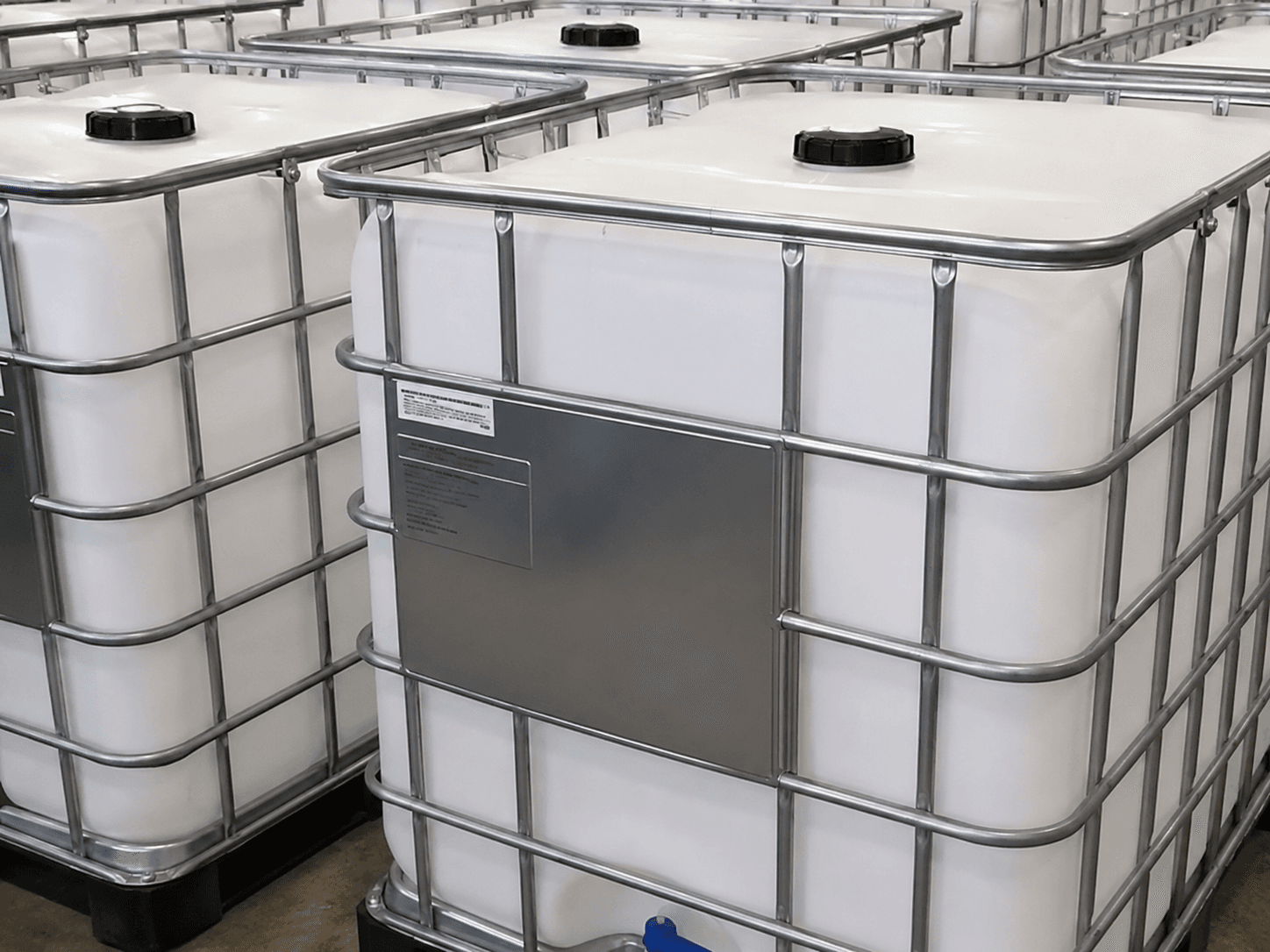
Standard IBC Tote Sizes
The four most common IBC tote sizes, with complete specifications for each. Dimensions are listed as Length x Width x Height.
275 Gallon
HDPE / CompositeThe industry standard. The 275-gallon IBC is by far the most common size in commercial and industrial use. Its 40" x 48" footprint matches a standard GMA pallet, making it compatible with virtually every warehouse, dock, and transport system. This is the size you will encounter in the overwhelming majority of IBC applications, from chemical distribution to food ingredient storage to agricultural operations.
Chemical storage, food ingredients, water, solvents, agricultural products
330 Gallon
HDPE / CompositeThe 330-gallon IBC shares the same pallet footprint as the 275-gallon model but stands 8 inches taller. This additional height provides roughly 20% more capacity without requiring any additional floor space. It is an excellent choice for operations that need to maximize volume per pallet position, particularly in warehouses where floor space is at a premium. The taller profile does reduce stackability in some configurations.
High-volume liquid storage, water treatment, industrial chemicals
350 Gallon
Stainless SteelThe 350-gallon stainless steel IBC is built for demanding applications where HDPE is not suitable. Constructed from 304 or 316 stainless steel, these containers handle aggressive chemicals, high-temperature products, and applications requiring absolute purity. The significantly higher empty weight reflects the robust all-metal construction. Stainless IBCs are designed for hundreds of use cycles and decades of service life.
Pharmaceuticals, aggressive chemicals, food-grade applications, high-temperature products
550 Gallon
Stainless SteelThe 550-gallon stainless steel IBC is the largest standard configuration. Standing nearly 6 feet tall, this container doubles the capacity of a standard 275-gallon unit while maintaining a similar pallet footprint. These are specialty containers used in operations that need maximum volume in a single transportable unit. Their height requires careful consideration of facility clearances, dock door heights, and transport constraints.
Large-volume chemical processing, brewing, winemaking, industrial water systems
Pallet Compatibility Matrix
Not every IBC size is compatible with every pallet type. This matrix shows which pallet options are available for each container size.
Stainless steel IBCs typically use integrated steel pallet bases due to weight and durability requirements. HDPE and wood pallets are not rated for the heavy loads associated with filled stainless steel containers.
IBC Tote Types Explained
IBC totes are manufactured in three primary construction types, each suited to different applications, budgets, and regulatory requirements.
HDPE Poly (Blow-Molded)
Most CommonThe standard HDPE IBC features a single-piece, blow-molded high-density polyethylene bottle housed inside a tubular galvanized steel cage. The bottle is naturally translucent, allowing visual inspection of fill levels. HDPE is chemically resistant to a wide range of substances, including most acids, bases, and solvents.
- ✓FDA-compliant grades available for food contact
- ✓Lightweight — easy to handle when empty
- ✓Cost-effective for single and multi-use applications
- ✓UV-stabilized options for outdoor storage
- ✓Bottle can be replaced without discarding the cage
Composite IBC
VersatileComposite IBCs combine an inner HDPE bottle with an outer cage and a pallet base that may be steel, HDPE, or wood. The term "composite" refers to this multi-material construction. These are the most common type in general industrial use and are what most people mean when they say "IBC tote." They are designed to be reconditioned by replacing the inner bottle while retaining the cage and pallet.
- ✓Rebottleable — extends cage life by 3-5x
- ✓Multiple pallet options (steel, HDPE, wood)
- ✓Available in 275 and 330 gallon sizes
- ✓Excellent chemical resistance
- ✓Ideal for reconditioning programs
Full Stainless Steel
PremiumStainless steel IBCs are constructed entirely from 304 or 316L stainless steel, including the tank body, frame, and often the pallet. They are designed for the most demanding applications: aggressive chemicals, high-purity pharmaceuticals, high-temperature products, and environments where HDPE would degrade or contaminate the contents. Their initial cost is significantly higher, but their lifespan of decades makes them economical over time.
- ✓Handles temperatures up to 300+°F
- ✓316L grade for maximum corrosion resistance
- ✓CIP (clean-in-place) compatible
- ✓20+ year service life with proper maintenance
- ✓Available in 350 and 550 gallon configurations
Weight Capacity by Product Density
The effective capacity of an IBC depends on the specific gravity of your product. Heavier liquids reach the weight limit before the volume limit.
Maximum gross weight for a standard 275-gallon composite IBC is approximately 2,200 lbs (1,000 kg). Always check the specific IBC data plate for the exact maximum gross weight rating.
IBC-to-Drum Conversion Calculations
Switching from drums to IBCs? Here are the conversion ratios to help you plan your transition and calculate space savings.
55-Gal Drums per 275-Gal IBC
One 275-gallon IBC replaces five standard 55-gallon drums, consolidating storage and reducing handling.
Floor Space Saved
An IBC occupies approximately 33% less floor space than the equivalent volume stored in 55-gallon drums.
Fewer Handling Events
Moving one IBC versus five drums means 80% fewer forklift operations, reducing labor costs and handling damage.
Single Dispensing Point
One bottom-discharge valve versus five drum bungs — faster, cleaner dispensing with fewer connection and disconnection steps.
Full Conversion Table
Here are the complete drum-to-IBC equivalents for planning your container transition:
Metric / Imperial Conversion Tables
Working with international partners or metric-based specifications? These conversion tables cover the most commonly needed IBC-related measurements.
Volume Conversions
Dimension & Weight Conversions
Size Recommendations by Industry
Different industries have different optimal IBC configurations. Here are our recommendations based on years of experience serving each sector.
Food & Beverage
275-gallon HDPE/composite with HDPE pallet for hygiene. Food-grade resin, FDA-compliant. Steel pallet acceptable for non-cleanroom applications. 330-gallon for high-volume ingredient storage.
275 gal HDPE recommendedChemical Distribution
275-gallon composite with steel pallet for maximum durability. UN-rated for hazmat transport if applicable. Stainless steel for aggressive chemicals. Check compatibility charts before selecting HDPE.
275 gal steel pallet recommendedAgriculture
275-gallon HDPE with steel or wood pallet. UV-stabilized bottles for outdoor storage. Grade B or C is typically sufficient for fertilizer and water storage. 330-gallon for high-volume irrigation supply.
275 gal Grade B recommendedPharmaceutical
350-gallon stainless steel for active ingredients and high-purity applications. 275-gallon HDPE acceptable for cleaning agents and non-API materials. Full traceability documentation required.
350 gal stainless recommendedBrewing & Winemaking
350-gallon or 550-gallon stainless steel for fermentation, storage, and transfer. CIP-compatible designs for sanitary cleaning. 316L grade recommended for wine applications due to acid resistance.
350-550 gal stainless recommendedWater Storage
275-gallon HDPE for rainwater, irrigation, and process water. UV covers essential for outdoor use. Food-grade HDPE required for potable water. 330-gallon for maximum volume in limited space.
275 gal HDPE recommendedIBC Pallet Types
The pallet base is a critical component that affects handling, durability, weight, and compatibility with your equipment. Three pallet types are standard in the industry.
Steel Pallet
Tubular galvanized steel pallets are the most durable option. They resist damage from forklifts, withstand heavy loads, and last through many reconditioning cycles. Steel pallets are 4-way entry, meaning forks can approach from any side. They add weight but provide the longest service life and the highest load ratings.
HDPE Plastic Pallet
Molded HDPE pallets are lighter than steel and resistant to corrosion, chemicals, and moisture. They are easier on warehouse floors and do not rust in wet environments. However, they are more susceptible to cracking from forklift impact and have a shorter service life under heavy use. HDPE pallets are common in food and pharmaceutical applications where hygiene is a priority.
Wood Pallet
Wood pallets are the most affordable option and are commonly found on single-use or export IBCs. They are acceptable for many industrial applications but have the shortest lifespan. Wood is susceptible to moisture damage, splintering, and pest infestation. ISPM-15 heat treatment is required for international shipments. Wood pallets are generally not recommended for reconditioning programs.
Weight Ratings & Stackability Rules
IBC totes are designed to be stacked, which is one of their primary advantages over drums and other bulk containers. However, safe stacking depends on understanding the load ratings, the condition of the container, and the specific stacking configuration.
Maximum Gross Weight
A standard 275-gallon composite IBC has a maximum gross weight (contents plus container) of approximately 2,200 lbs (1,000 kg). This is based on a product with a specific gravity of 1.0 (water). Products heavier than water — such as many chemicals and syrups — will reach the weight limit before the volume capacity is full. Always calculate gross weight based on the specific gravity of your product, not just the volume.
Stacking Specifications
New, filled 275-gallon IBCs are typically rated for stacking 4 high. This means the bottom container must support the weight of three filled containers above it. The stacking load rating is typically printed on the IBC's data plate. For used or reconditioned IBCs, it is critical to inspect the cage for any deformation, bent tubes, or weld cracks that could compromise stacking integrity.
Comprehensive Stacking Safety Rules
- Never stack IBCs beyond the manufacturer's rated capacity
- Ensure the surface beneath the bottom IBC is level and can support the total load
- Align containers precisely — offset stacking creates dangerous load imbalances
- Reduce stacking height for used IBCs with visible cage damage
- Do not stack IBCs with different footprint sizes on top of each other
- Consider seismic requirements if your facility is in an earthquake zone
- Empty IBCs should be nested or stored flat — never stacked empty without securing
- Ensure cage corners are fully seated on the pallet corners of the container below
- Do not stack filled IBCs on an empty IBC — the empty container will collapse
- Account for floor load capacity — four stacked filled IBCs weigh nearly 10,000 lbs
- Leave adequate clearance above the top IBC for sprinkler systems and lighting
- In outdoor storage, reduce stacking height in high-wind areas to prevent toppling
Valve Sizes & Top Openings
The valve and lid configuration determines how product flows in and out of your IBC. Choosing the right fittings is essential for compatibility with your filling and dispensing equipment.
Bottom Discharge Valves
2" NPS Butterfly Valve
The standard discharge valve on most HDPE and composite IBCs. The 2-inch NPS (National Pipe Straight) thread is the industry default. Butterfly valves provide full-bore flow, meaning the internal passage matches the pipe diameter with no restriction. They open and close with a quarter-turn handle and are suitable for most liquids, including viscous products.
2" Cam Lock Fitting
Cam lock (camlock) fittings provide quick-connect capability for hoses and dispensing lines. Available in Types A through F, with Type A (male adapter) and Type D (female coupler) being the most common on IBC applications. Cam locks allow tool-free connection and disconnection, which speeds up filling and dispensing operations. They are available in polypropylene, stainless steel, and aluminum.
Ball Valve
Ball valves provide precise flow control and positive shutoff. They are more common on stainless steel IBCs and applications where drip-free closure is critical. Ball valves are available in 2" and 3" sizes and can handle higher pressures than butterfly valves.
Top Openings
6" Screw Cap Lid (150mm)
The primary fill opening on most IBCs. The 6-inch (150mm) threaded cap provides a wide opening for filling, cleaning, and visual inspection of contents. It typically features a vented cap or a solid cap depending on the application. Vented caps include a pressure-relief mechanism that prevents vacuum or pressure buildup during temperature changes, which is essential for safe storage and transport.
2" Bung (NPS Thread)
A secondary opening located on the top of the IBC, adjacent to the main lid. The 2-inch bung is used for secondary filling ports, sampling, venting, or connecting recirculation lines. Not all IBCs include a bung — it depends on the manufacturer and the intended application. Bungs typically use NPS threading and accept standard plugs, adapters, or vent caps.
Dust Cap / Rain Cap
A protective cover that fits over the valve outlet when the IBC is not actively being dispensed. Dust caps prevent contamination from airborne particles, insects, and moisture. They are inexpensive but critical for maintaining product integrity, especially for IBCs stored outdoors or in dusty environments.
Understanding UN/DOT Markings
Every IBC tote manufactured for transporting regulated materials carries a UN marking that encodes critical information about its design, testing, and authorization. Understanding these markings is essential for DOT compliance.
Reading a UN Marking
A typical UN marking on a composite IBC looks like this:
UN 31HA1/Y/0623/USA/SCHUTZ/10HZ123United Nations certification symbol, confirming the container meets international transport standards.
Container type code. "31" = rigid IBC for liquids. "H" = plastic with structural equipment. "A1" = fitted with a bottom discharge.
Packing group. "X" = PG I, II, III (most dangerous). "Y" = PG II, III. "Z" = PG III only (least dangerous).
Date of manufacture — June 2023. The first two digits are the month, the last two are the year.
Country of manufacture or approval. This confirms the IBC was certified under U.S. DOT regulations.
Manufacturer name and unique serial or approval number for traceability.
Why UN Markings Matter
UN markings are not optional decorations. They are legal requirements under DOT 49 CFR and international IMDG and ADR regulations. Transporting hazardous materials in an IBC without valid UN markings, or in an IBC with expired certification, is a federal violation that can result in significant fines, shipment rejections, and liability exposure. Key points to remember:
- •Composite IBCs used for hazardous materials must be used or reconditioned within 5 years of manufacture of the inner receptacle
- •The packing group rating determines which hazard classes the IBC is authorized to carry
- •Reconditioned IBCs must be re-marked with the reconditioner's identification and the reconditioning date
- •Damaged or illegible UN markings render the IBC non-compliant for hazmat transport
- •Non-hazardous applications (water, non-regulated chemicals) do not require UN-rated containers
How to Read IBC Date Codes
Every IBC tote carries a date code that indicates when it was manufactured. This date is critical for determining the container's age, remaining service life, and regulatory compliance status. Date codes appear in two primary locations: molded into the HDPE bottle itself and stamped on the metal data plate attached to the cage.
Bottle Manufacture Date
The HDPE bottle typically has a date code molded directly into the plastic, usually near the bottom or on the side. This code appears as a clock-like dial with numbers 1 through 12 around the perimeter (representing months) and a two or four-digit year in the center. An arrow or dot points to the month of manufacture. For example, a dot pointing to "6" with "23" in the center means the bottle was manufactured in June 2023.
Cage and Data Plate Date
The steel cage typically carries a metal data plate riveted or welded to one of the uprights. This plate includes the UN marking (which contains the manufacture date in MMYY format), the manufacturer's name, the maximum gross weight, the stacking load rating, and the tare weight. On reconditioned IBCs, an additional plate or sticker indicates the reconditioning date and the reconditioner's identification.
Why Date Codes Matter
- Regulatory compliance:Composite IBCs for hazmat must be within 5 years of the inner bottle's manufacture date
- Material degradation: HDPE degrades over time from UV exposure and chemical interaction — older bottles may be more brittle or permeable
- Resale value: Newer IBCs command higher prices on the secondary market
- Reconditioning eligibility: IBCs with very old cages may not be worth rebottling if the cage is approaching end-of-life
- Warranty claims: Manufacturer warranties are date-dependent and require the original manufacture date to be legible
How to Choose the Right IBC Size
Selecting the right IBC size involves balancing volume needs, space constraints, handling equipment, product characteristics, and budget. Here is a systematic approach to making the right choice.
Step 1: Calculate Your Volume Requirements
Start with your actual volume needs. How much product do you need to store or transport per container? If your batch sizes are 200-250 gallons, a 275-gallon IBC provides the right capacity with headroom. If you regularly handle 300+ gallon batches, a 330-gallon IBC avoids splitting product across two containers. For very large volumes, consider whether a 550-gallon stainless IBC or multiple standard IBCs is more practical.
Step 2: Check Your Space Constraints
Measure your storage area, doorways, dock doors, and transport vehicles. The standard 40" x 48" footprint fits through a standard 36" doorway diagonally and sits perfectly on a standard pallet rack. The 330-gallon model's extra 8 inches of height may not clear low ceilings or mezzanines. The 550-gallon model at 71" tall will not fit through a standard 7-foot dock door on a pallet jack.
Step 3: Consider Your Product
What are you storing? HDPE IBCs handle most chemicals, food products, and water-based solutions. But aggressive solvents, concentrated acids, or products above 150°F may require stainless steel. Check chemical compatibility charts and consult your supplier if you are unsure. Also consider the product's specific gravity — heavy liquids may hit weight limits before volume limits.
Step 4: Evaluate Your Handling Equipment
What forklifts and pallet jacks do you have? Standard IBCs on steel or HDPE pallets are compatible with all standard material handling equipment. However, the weight of filled stainless steel IBCs (2,500+ lbs for a 350-gallon unit) may exceed the capacity of smaller forklifts. Ensure your handling equipment is rated for the loaded weight.
Step 5: Factor in Budget and Lifecycle
New HDPE IBCs cost $200-$400 depending on configuration. Reconditioned IBCs from a reputable supplier like Rochester IBC run 40-60% less. Stainless steel IBCs cost $2,000-$5,000+ new but last for decades. For short-term or single-use applications, reconditioned HDPE is almost always the most economical choice. For long-term, repeated use with demanding products, stainless steel may have a lower total cost of ownership.
Continue Your Research
Now that you understand IBC sizes and specifications, explore our buying guide or browse our available inventory.