Frequently Asked Questions
Expert answers to the most common questions about IBC totes. From basic sizing and materials to cleaning procedures, stacking limits, food-grade requirements, and delivery logistics.
Have a Question Not Listed Here?
Fill in the details and we'll get back to you within 24 hours.
Everything You Need to Know About IBC Totes
We receive dozens of questions every week from businesses, individuals, and organizations exploring IBC totes for the first time or looking to deepen their understanding of bulk container options. Below, we have compiled the most frequently asked questions with thorough, expert-level answers based on our team's extensive experience buying, selling, reconditioning, and recycling thousands of IBC totes.
If your question is not answered here, contact our team directly. We are happy to provide personalized guidance based on your specific application, volume requirements, and budget.
What is an IBC tote?
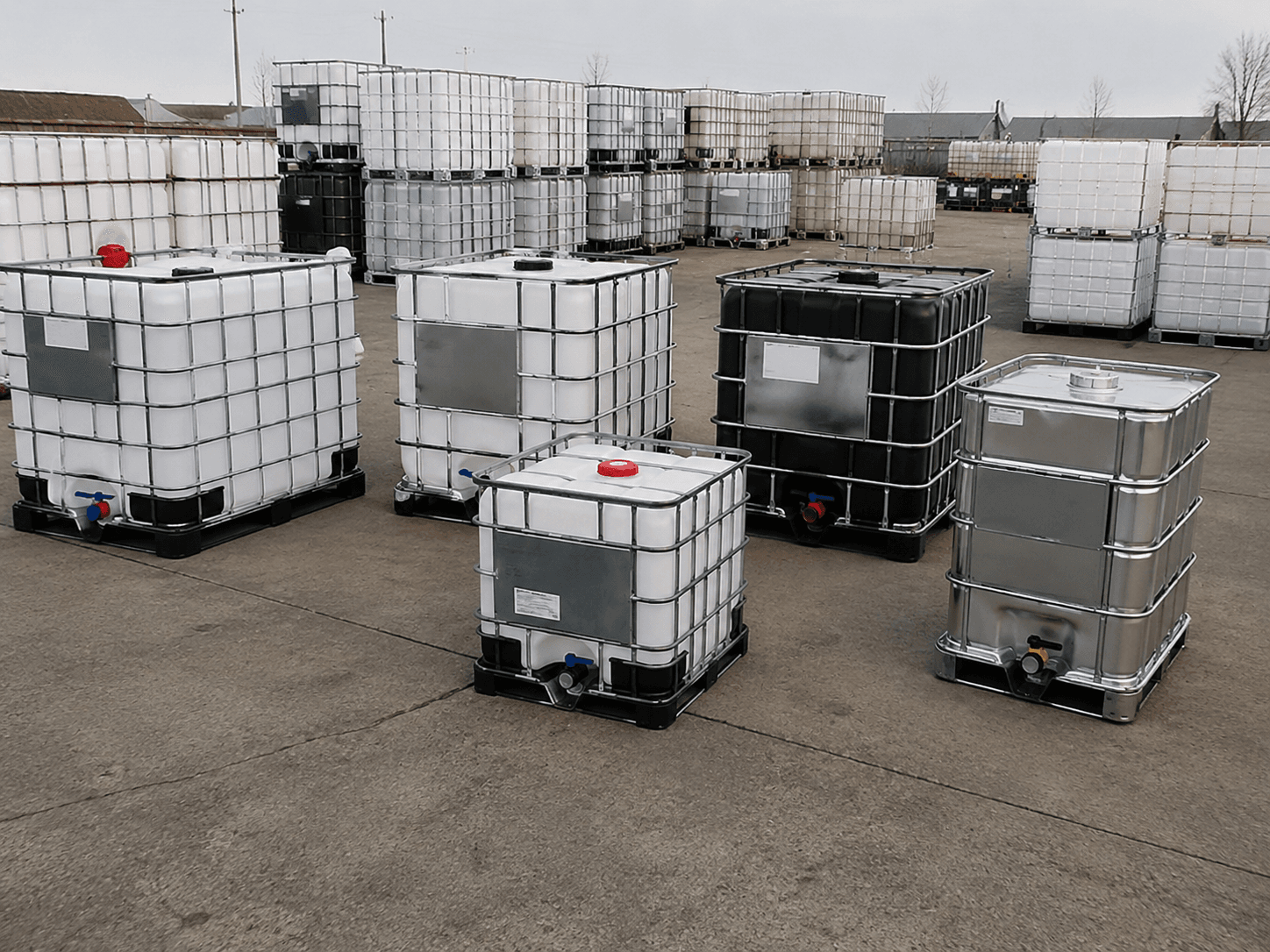
An IBC (Intermediate Bulk Container) tote is a reusable industrial container designed for storing and transporting bulk liquids and granular materials. The most common type consists of a blow-molded high-density polyethylene (HDPE) bottle encased in a tubular galvanized steel cage, mounted on a pallet base. Standard IBCs hold 275 gallons (1,040 liters) and feature a 6-inch top fill opening and a 2-inch bottom discharge valve. They are used across virtually every industry that handles bulk liquids, including chemical manufacturing, food processing, agriculture, pharmaceuticals, water treatment, and more. IBCs replaced drums and smaller containers in many applications because they hold more product per unit of floor space, are easier to fill and dispense, and can be moved with standard forklifts and pallet jacks.
What sizes do IBC totes come in?
IBC totes are available in four standard sizes. The 275-gallon (1,040 L) model is by far the most common, measuring 40" x 48" x 46" and fitting a standard pallet footprint. The 330-gallon (1,249 L) model shares the same footprint but stands 8 inches taller at 54". These two sizes are available in HDPE/composite construction. For stainless steel IBCs, the standard sizes are 350-gallon (1,325 L) at 42" x 48" x 47" and 550-gallon (2,082 L) at 42" x 48" x 71". The 275-gallon size accounts for the vast majority of IBCs in commercial circulation and is the most readily available on both the new and secondary markets. Visit our Size Guide for complete specifications on every standard IBC configuration.
What is a reconditioned IBC?
A reconditioned IBC is a used container that has been professionally restored to like-new functional condition. At Rochester IBC, reconditioning means the original HDPE inner bottle is removed and replaced with a brand-new bottle (a process called "rebottling"), the steel cage is thoroughly inspected for structural integrity, the discharge valve and top lid are replaced with new fittings, and the pallet is inspected and repaired or replaced as needed. The result is a container with a new interior that performs identically to a new IBC, housed in an inspected and verified cage, at 40-60% less than the cost of a brand-new unit. Reconditioning is also an environmentally responsible choice because it extends the useful life of the steel cage and pallet, reducing the demand for virgin materials.
Are used IBCs safe?
Used IBCs can be perfectly safe when sourced from a reputable supplier and used appropriately. Safety depends on several factors: knowing what was previously stored in the container, the condition of the bottle and cage, the thoroughness of cleaning, and matching the container to an appropriate application. A used IBC that previously held food-grade vegetable oil and has been properly cleaned is safe for many applications. However, a used IBC with unknown prior contents should never be used for food, drinking water, or sensitive products. At Rochester IBC, we track prior contents on every container we handle and provide honest assessments of what each IBC is suitable for. We never sell a container for an application it is not appropriate for.
How long does an IBC tote last?
The lifespan of an IBC tote depends on the material, usage conditions, and maintenance. A standard HDPE/composite IBC typically lasts 5 to 7 years under normal industrial use. UV exposure, aggressive chemicals, extreme temperatures, and rough handling can shorten this lifespan. Reconditioning (rebottling) effectively resets the clock on the inner bottle while retaining the cage, which can outlast multiple bottles. A well-maintained steel cage can last 10-15 years through several rebottling cycles. Stainless steel IBCs are the durability champions, with service lives of 20 years or more when properly maintained. They can be cleaned and reused hundreds of times without degradation. The key to maximizing IBC lifespan is proper storage (out of direct sunlight), gentle handling, and prompt cleaning after use.
What is a food grade IBC?
A food-grade IBC is a container manufactured with FDA-compliant materials and designated for contact with food products. The HDPE bottle must be made from virgin, FDA-approved resin — not recycled plastic. The valve, lid, and gaskets must also be food-safe. For used or reconditioned food-grade IBCs, there is an additional critical requirement: documented prior-contents history. The container must have previously held only food-grade products, and there must be a traceable chain of custody proving this. Simply being made from FDA-compliant HDPE does not make a used IBC food-grade if it previously held industrial chemicals. At Rochester IBC, we maintain careful records of prior contents and clearly label which IBCs qualify for food-grade applications. If chain-of-custody documentation is not available, the container is not sold as food-grade, regardless of its physical condition.
How do I clean an IBC tote?
Cleaning an IBC tote requires appropriate methods based on what was previously stored and what will be stored next. For basic cleaning of non-hazardous residues, triple-rinsing with hot water is a standard starting point: fill approximately one-third with hot water, secure the lid, agitate by rocking or rolling, then drain completely through the bottom valve. Repeat three times. For more thorough cleaning, a pressure washer inserted through the top opening is effective. For food-grade cleaning, sanitizing solutions (typically quaternary ammonium or peracetic acid-based cleaners) must be used after the water rinse. For chemical residues, the cleaning method depends entirely on the specific chemical — consult the Safety Data Sheet (SDS) for the prior product. Professional reconditioning facilities like Rochester IBC use specialized automated wash systems that deliver consistent, documented cleaning results that manual methods cannot match.
Can IBC totes be stacked?
Yes, IBC totes are specifically designed to be stacked, which is one of their major advantages over drums and other bulk containers. A standard new 275-gallon IBC is rated for stacking up to 4 containers high when filled. The 330-gallon model is typically rated for 3 high due to its greater height and the resulting higher center of gravity. Stacking ratings are printed on the IBC data plate. However, there are critical safety rules: containers must be aligned precisely with no overhang, the bottom surface must be level and rated for the total load, and you should never stack IBCs with damaged cages. For used IBCs, inspect the cage uprights and weld points before stacking — any deformation reduces the safe stacking load. Empty IBCs should not be stacked unless they are secured against tipping, as they are top-heavy when empty and can fall in wind or from minor vibration.
What are IBC totes made of?
IBC totes are constructed from several materials depending on the type. The most common composite IBC consists of three main components: (1) the inner bottle, blow-molded from high-density polyethylene (HDPE), which provides chemical resistance and contains the product; (2) the outer cage, fabricated from tubular galvanized steel, which provides structural support, protection, and stackability; and (3) the pallet base, which may be made of steel, molded HDPE plastic, or wood, and provides the interface for forklift and pallet jack handling. Fittings include a polypropylene or brass butterfly valve at the bottom discharge, a screw-cap lid at the top fill opening, and various gaskets made from materials compatible with the intended contents. Full stainless steel IBCs use 304 or 316L stainless steel for the tank body, frame, and often the pallet, providing superior chemical resistance and temperature tolerance.
Do you deliver?
Yes, Rochester IBC provides delivery service throughout the greater Rochester metropolitan area and across the Northeast region. We operate our own fleet of transport vehicles equipped for safe IBC handling. Delivery options include flatbed trucks for large orders (a standard flatbed can carry approximately 18-20 empty IBCs or 8-10 filled units), box trucks for smaller quantities, and specialized transport for hazmat-rated containers. We also offer pickup service for used IBCs — if you have containers to sell or recycle, we will come to your facility, load them, and haul them away. Delivery pricing depends on quantity, distance, and whether you need empty or filled containers transported. Contact us for a delivery quote specific to your location and requirements. Many customers in the Rochester area find that our delivery charges are offset by the convenience and the savings on our IBC pricing.
How much does a used IBC cost?
Used IBC pricing varies based on condition, age, prior contents, and market conditions. As a general guide for 275-gallon HDPE IBCs in the Rochester area: Grade A (premium condition, clean, lightly used) runs $100-$175; Grade B (moderate wear, fully functional) runs $75-$125; and Grade C (heavy wear, suitable for non-critical use) runs $40-$75. Reconditioned (rebottled) IBCs, which feature a brand-new inner bottle in an inspected cage, typically run $120-$200, representing the best value for most applications. Stainless steel IBCs hold their value better and used units typically sell for $800-$2,500 depending on size, grade, and condition. Volume discounts are available for orders of 10 or more units. Contact Rochester IBC for current pricing — we provide free quotes and can usually beat the pricing you find from online brokers because we eliminate the middleman.
What's the difference between grades?
The IBC grading system (A, B, C) communicates the cosmetic and functional condition of used containers. Grade A is premium condition: the bottle is clean and clear with minimal staining, the cage is straight with no structural damage, and the container has typically been used once for a known product. Grade B is standard industrial condition: the bottle may show moderate staining or discoloration, the cage may have minor cosmetic dents, but everything is structurally sound and fully functional. Grade B represents the best price-to-quality ratio for most applications. Grade C is economy condition: heavy staining, visible wear on the cage, cosmetic defects — but still structurally functional for non-critical applications like waste collection, non-potable water storage, or general non-food storage. All grades at Rochester IBC are inspected for structural integrity — the grading primarily reflects cosmetic condition, not safety.
Can I use IBCs for water storage?
Yes, IBC totes are widely used for water storage, but the type of water use determines the appropriate container. For non-potable water (irrigation, rainwater collection, industrial process water, fire suppression reserves), used Grade B or C IBCs are cost-effective and perfectly suitable. For potable (drinking) water storage, you need a food-grade IBC with documented prior contents — the container must have been manufactured from FDA-compliant resin and must have previously held only food-safe products. Important considerations for water storage: (1) UV exposure promotes algae growth in transparent HDPE bottles — use a UV cover or store indoors; (2) stagnant water can develop bacterial growth — use or circulate stored water regularly; (3) water weighs approximately 8.34 lbs per gallon, so a full 275-gallon IBC weighs over 2,400 lbs — ensure your floor or ground surface can support this load.
What is the valve size on an IBC?
The standard bottom discharge valve on most HDPE and composite IBCs is 2 inches (2" NPS — National Pipe Straight thread). This is a butterfly-style valve that opens and closes with a quarter-turn handle, providing full-bore flow. The 2" NPS thread is compatible with standard cam lock fittings, hose barb adapters, and dispensing accessories. Some IBCs, particularly stainless steel models, feature 2" or 3" ball valves instead of butterfly valves. The top fill opening is a 6-inch (150mm) screw cap, and some IBCs also include a 2" bung (secondary opening) on the top for venting, sampling, or recirculation connections. When purchasing an IBC, verify that the valve type and thread size are compatible with your existing filling and dispensing equipment. Adapter fittings are available but add cost and potential leak points.
How many IBCs fit on a truck?
Truck loading capacity depends on the truck type and whether the IBCs are empty or filled. A standard 53-foot flatbed trailer can carry approximately 18-20 empty 275-gallon IBCs in a single layer, or 36-40 if double-stacked (which is common for empty containers). For filled IBCs, the constraint shifts from space to weight: a full 275-gallon IBC weighs approximately 2,400 lbs (with water-weight product), so a 53-foot trailer with an 44,000 lb payload limit can carry roughly 18 filled units. A standard 26-foot box truck can handle approximately 8-10 empty IBCs or 4-6 filled units depending on the truck's payload rating. For local deliveries, Rochester IBC uses various truck sizes optimized for the order quantity. When planning orders, consider both the number of units and total weight to determine the most efficient transport configuration.
How do I know if my IBC needs reconditioning or recycling?
The decision between reconditioning and recycling depends on the structural condition of the container. An IBC is a candidate for reconditioning if: the steel cage is structurally sound with no cracked welds, severely bent uprights, or major corrosion; the pallet is intact and stable; and the overall cage geometry is true (not twisted or racked). The inner HDPE bottle does not need to be in good condition for reconditioning — that is the part we replace. An IBC should be recycled (not reconditioned) if: the cage has cracked or broken welds at structural joints, the uprights are severely bent or crushed, there is significant corrosion that has weakened the steel, or the pallet is cracked or deformed beyond repair. At Rochester IBC, we evaluate every incoming container and make an honest determination. If a tote can be safely reconditioned, we recondition it. If not, we disassemble it and recycle each material separately — nothing goes to landfill.
What certifications does Rochester IBC hold?
Rochester IBC maintains several operational certifications and compliance standards relevant to IBC reconditioning and recycling. Our facility operates in full compliance with Monroe County and New York State wastewater discharge regulations, with documented testing records available for review. Our reconditioning processes comply with DOT 49 CFR requirements for IBC reconditioning, including proper re-marking and documentation. Our workplace meets OSHA safety standards, and all team members receive ongoing safety training. We maintain comprehensive Safety Data Sheet (SDS) records for all prior contents handled, and our food-grade reconditioning protocols follow FDA guidelines for containers intended for food-contact applications. We also carry full insurance coverage including general liability, commercial auto, workers compensation, and environmental liability. Certificates of insurance and compliance documentation are available upon request.
Can you handle hazardous waste IBCs?
Rochester IBC can accept and process IBCs that previously contained hazardous materials, subject to specific conditions. We routinely handle totes that held regulated chemicals, solvents, and other hazardous substances classified under DOT and EPA regulations. However, there are important distinctions. We can accept IBCs that contained hazardous products for which proper cleaning and reconditioning protocols exist — most industrial chemicals, solvents, and cleaning agents fall into this category. We track all prior contents via SDS documentation and apply cleaning procedures specific to the chemical involved. For containers that held extremely hazardous or restricted waste (such as radioactive materials, certain biohazards, or materials requiring specialized disposal permits), we may not be able to accept them directly but can refer you to appropriate hazardous waste disposal facilities. Contact us with the SDS for the prior contents and we will advise on whether the container can be processed at our facility.
What is your minimum order quantity?
Rochester IBC has no minimum order quantity. We are happy to sell a single IBC tote to an individual or small business, and we are equally equipped to fulfill orders of hundreds of containers for large industrial operations. That said, our pricing is structured to reward volume: orders of 10 or more units typically qualify for volume discounts of 10-15%, and orders of 50 or more units can receive even deeper discounts along with dedicated account management. For pickup orders (where you come to our facility), there is truly no minimum — even one container is welcome. For delivery orders, we do require a minimum order that justifies the delivery cost, which varies by distance. For local Rochester deliveries, the practical minimum is usually 4-6 containers. For longer-distance deliveries, the minimum may be higher to make the transportation cost per unit reasonable. Contact us with your specific needs and we will work out the most cost-effective arrangement.
Do you offer IBC rental programs?
While Rochester IBC primarily operates as a buy-sell-recondition-recycle business rather than a rental company, we do offer arrangements that function similarly to a rental program for qualified customers. Our Tote Swap Program allows you to purchase reconditioned IBCs, use them, and return them to us when empty. We buy back the used containers at a fair price, effectively reducing your net cost per use cycle to a fraction of the purchase price. For high-volume customers on our dedicated account program, we can set up recurring swap schedules that function very much like a rental — you always have a supply of clean, reconditioned containers, and you never have to worry about disposal or storage of empties. The economics often work out better than a traditional rental because you build equity in the containers rather than paying a per-day fee, and you have full flexibility on how long you keep them.
What payment methods do you accept?
Rochester IBC accepts a variety of payment methods to accommodate businesses of all sizes. For walk-in and pickup purchases, we accept company checks, cashier checks, and major credit cards (Visa, MasterCard, American Express). For established business accounts, we offer Net 30 payment terms upon credit approval — this is our most common arrangement for repeat customers. We also accept ACH (electronic bank transfer) and wire transfers for larger orders or out-of-area customers. For first-time customers placing large orders, we may require payment before shipment until a credit relationship is established. We provide detailed invoices for all transactions and can accommodate purchase order systems for companies that require them. If you have specific payment requirements or need to set up a corporate account, contact our office and we will work with your accounts payable process.
How do I prepare IBCs for pickup?
Preparing your used IBCs for pickup is straightforward, and proper preparation ensures the smoothest transaction. First, drain all remaining product from the container and close the bottom valve securely. Remove any custom fittings, hoses, or adapters you want to keep — we buy the container, not your accessories. If possible, triple-rinse the container with water to remove the bulk of any residue, though this is not strictly required as we will professionally clean all containers at our facility. Leave the original labels on the container — we use them to identify prior contents. Stage the containers in an area accessible by our truck, ideally on flat ground where a forklift can reach them. If the containers are indoors, ensure the path from the storage area to the loading dock is clear and wide enough for forklift traffic. Have your documentation ready: the number of containers, what they previously held, and any SDS information you have available. This information helps us provide an accurate buyback quote and speeds up the pickup process.
What areas do you service?
Rochester IBC is headquartered at 145 Commerce Drive in Rochester, NY, and our primary service area extends throughout the greater Rochester metropolitan area, all of upstate New York, and the broader Northeast region. For pickup and delivery services, we regularly serve customers within a 300-mile radius of Rochester, which includes all of New York State, Pennsylvania, New Jersey, Connecticut, Massachusetts, Vermont, New Hampshire, and portions of Maine, Ohio, and Ontario, Canada. For customers outside this radius, we can often arrange cost-effective shipping through our logistics partners. Our most active service corridors follow the major highway systems: I-90 (east-west through upstate NY), I-390 (north-south through the Finger Lakes), I-490 (Rochester metro), and I-81 (Syracuse corridor). Customers in the Rochester metro area enjoy the fastest turnaround times and the most flexible scheduling. If you are unsure whether your location falls within our service area, contact us — we are usually able to find a way to serve you.
Can I visit your facility?
Absolutely. Rochester IBC welcomes facility visits, and we actively encourage prospective customers to see our operation firsthand. We believe that transparency builds trust, and we are proud of the reconditioning facility we have built at 145 Commerce Drive. For a full facility tour, we recommend scheduling an appointment so we can assign a team member to walk you through our entire process — from receiving and inspection through washing, reconditioning, and final quality verification. Tours typically take 30-45 minutes. If you are simply picking up or dropping off containers, no appointment is needed during business hours (Monday through Friday, 7 AM to 5 PM). Walk-in customers are welcome. For safety, all visitors must check in at the office before entering production or storage areas. We provide safety vests and eye protection for anyone touring the facility. Closed-toe shoes are required in all production areas. Contact us by email at info@rochesteribc.com or call during business hours to schedule your visit.
Do you offer emergency or rush delivery?
Yes, Rochester IBC offers emergency and rush delivery services for customers who need containers urgently. We understand that production delays and unexpected demand can create time-sensitive needs, and we do our best to accommodate rush requests. For customers in the greater Rochester area, same-day delivery is often possible for in-stock items if the request comes in before noon on a business day. Next-day delivery is available for most locations within our 300-mile service radius, subject to inventory availability and truck scheduling. Rush orders may incur a surcharge to cover the additional logistics costs of expedited scheduling and dedicated transport — we will quote this upfront so there are no surprises. For customers on our dedicated account program, rush delivery is prioritized and may not incur additional charges depending on the terms of your account agreement. In a true emergency, call us directly rather than using email or the contact form — a phone call is the fastest way to get the process started. Our team will assess inventory, schedule transport, and provide you with a firm delivery commitment as quickly as possible.
Explore Related Resources
For more detailed information on specific topics, explore our comprehensive guides.
Size Guide
Complete dimensions, weights, and specifications for every standard IBC size.
View GuideBuying Guide
How to choose between new, used, and reconditioned IBCs for your application.
View GuideArticles
In-depth articles on IBC recycling, sustainability, maintenance, and industry insights.
Read ArticlesStill Have Questions?
Our team of IBC specialists is ready to answer any question you have, no matter how specific or technical. Contact us for personalized guidance at no charge.