Reconditioned IBC Totes
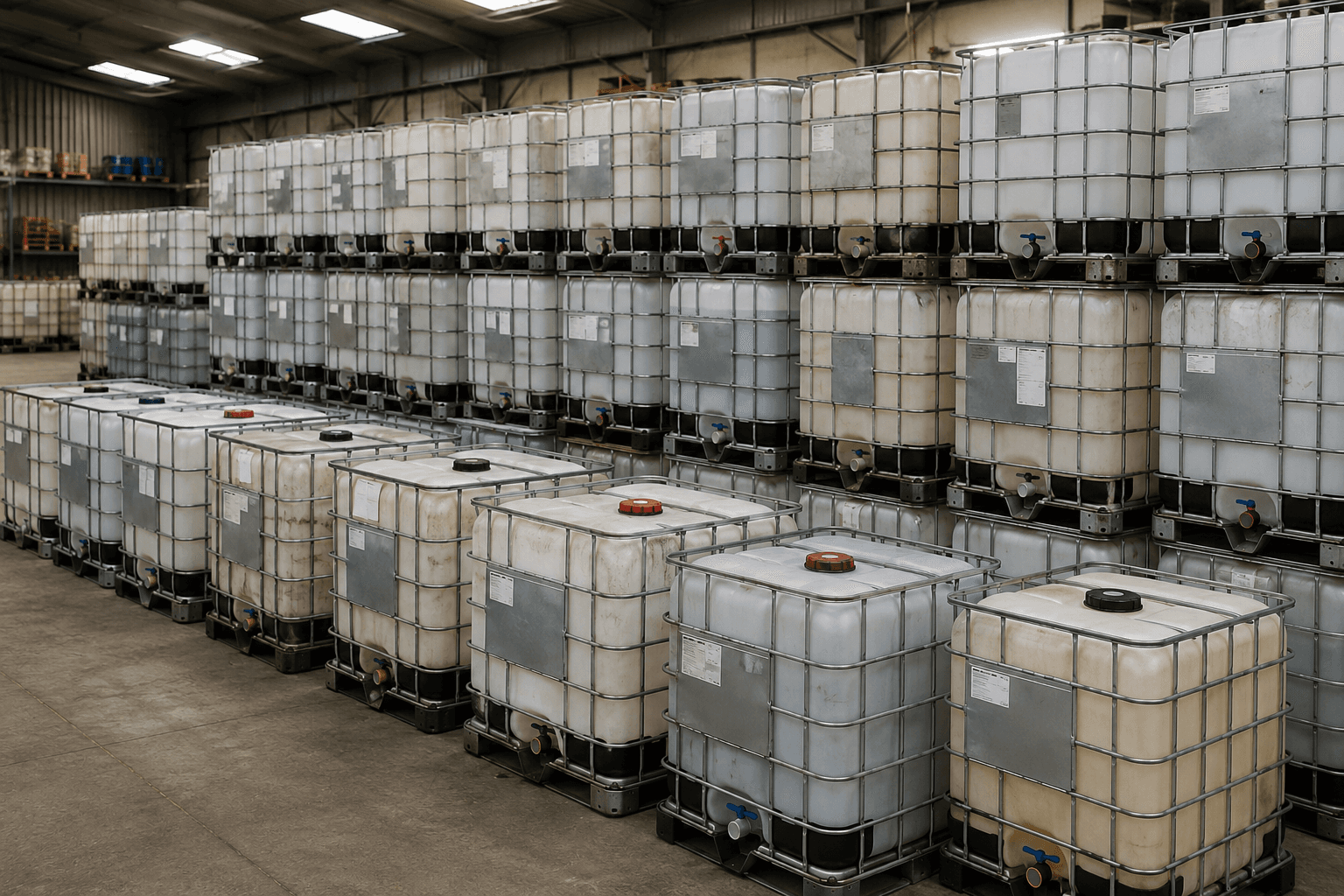
Every reconditioned IBC tote is a container saved from the landfill. Our 9-step reconditioning process restores used totes to like-new performance at 40-70% less than new -- without compromising quality, safety, or compliance.
Get Reconditioned IBC Pricing
Fill in the details and we'll get back to you within 24 hours.
The Most Sustainable Container
Is the One That Already Exists
Manufacturing a single new HDPE IBC tote requires approximately 150 pounds of virgin plastic resin, 25 pounds of steel for the cage, and significant energy for blow molding, galvanizing, and assembly. By reconditioning an existing container, we eliminate nearly all of that resource consumption and the associated carbon emissions.
Before and After: What Reconditioning Transforms
A used IBC tote arrives at our facility looking like it has been through service -- because it has. Here is what a typical container looks like when it comes in, and what it looks like when it leaves our reconditioning line.
Before Reconditioning
- Inner bottle stained or discolored from prior contents (chemicals, oils, food ingredients)
- Residual product film or deposits on interior surfaces
- Old valve assembly with worn seals, sticky operation, or slow drips
- Cap gasket compressed, cracked, or chemically degraded
- Steel cage showing surface rust, forklift dents, bent corners, or scuffed galvanization
- Pallet with damaged boards, bent steel, or missing fork entry guides
- Prior-use labels still adhered to cage and bottle surfaces
- Lingering odor from previous product stored in the container
- Dust, dirt, and weathering from outdoor storage at the prior user site
After Reconditioning
- Inner bottle thoroughly cleaned, inspected, and clear (Grade A) or replaced with brand-new virgin HDPE
- Interior surfaces free of residue, film, and deposits -- verified by visual and odor inspection
- Brand-new discharge valve assembly with fresh seals -- smooth operation and positive shutoff
- New cap with factory-fresh gasket providing a secure, leak-free top seal
- Steel cage straightened, repaired, and treated for corrosion -- structurally sound for stacking
- Pallet restored to flat, stable condition with 4-way forklift entry verified
- All prior-use labels removed, replaced with Rochester IBC reconditioning certification label
- No residual odor -- verified by trained inspection staff
- Pressure-tested, leak-checked, and graded A, B, or C with full documentation
The Rochester IBC 9-Step Reconditioning Process
We do not just rinse and resell. Our reconditioning program is a rigorous, documented process that transforms used containers into reliable, certified assets for your next application.
Intake & Prior-Use Assessment
Every incoming container is cataloged and assessed. We record the prior contents, manufacturer, age, UN marking, and overall condition. Containers with incompatible prior use (pesticides, toxic chemicals) are segregated for appropriate recycling -- they never enter the reconditioning line. This step ensures that the history of every tote we sell is known and documented.
Our intake team processes an average of 50 to 100 containers per day. Each one is photographed, assigned a unique tracking number, and entered into our inventory management system along with the supplier source, prior-use documentation (if available), manufacturing date code, and UN marking details. Containers that arrived without prior-use documentation are treated with the highest level of caution -- they undergo additional wash cycles and may be restricted to non-food, non-pharmaceutical applications. This conservative approach protects our customers and our reputation for traceable, trustworthy containers.
Full Disassembly
The IBC is broken down to its core components: inner bottle, cage/frame, pallet, valve assembly, cap, and all gaskets and seals. Each component is evaluated independently. This allows us to replace individual parts while preserving components that are still in excellent condition, maximizing both value and sustainability.
Disassembly is performed by trained technicians using pneumatic tools and dedicated workstations designed for safe, efficient IBC breakdown. The inner bottle is removed from the cage by releasing the retention band and lifting the bottle free. The valve assembly is removed with the gasket for separate inspection. The cap and cap gasket are removed for replacement. Every removed component is placed in a designated area for the next stage of evaluation. This systematic approach ensures nothing is missed and every part receives individual attention.
High-Pressure Washing
The inner bottle is cleaned using automated high-pressure wash systems with water heated to 180 degrees F. Depending on the prior contents, we apply alkaline detergent, acid rinse, or solvent wash cycles. The exterior cage and pallet are separately pressure-washed and degreased. Every surface that could contact the stored product is cleaned to a certified standard.
Our wash line features fully automated rotary spray heads that deliver 360-degree coverage at 1,500 to 3,000 PSI. The standard wash protocol is a three-stage process: hot alkaline detergent wash (to break down organic residues and oils), hot water rinse (to remove detergent), and final sanitizing rinse. For containers that previously held stubborn products like adhesives, resins, or dyes, we add a solvent pre-wash stage using compatible solvents that dissolve the residue without damaging the HDPE. Our wash water is collected, filtered, treated, and recycled through a closed-loop system that minimizes freshwater consumption and eliminates contaminated discharge.
Bottle Inspection & Replacement
The HDPE inner bottle is inspected under bright light for stress cracks, crazing, staining, warping, odor retention, and UV degradation. Bottles that do not meet our quality threshold are replaced with new, virgin HDPE bottles -- the cage and pallet are retained. This "rebottling" process delivers near-new performance at a fraction of the cost and environmental impact.
Bottle inspection is one of the most critical steps in our process. Technicians use high-intensity LED inspection lights to illuminate the bottle walls from the inside, making even hairline cracks and micro-crazing visible. They also perform a sniff test for odor retention -- some products (solvents, fragrances, certain chemicals) can permeate the HDPE and leave a residual odor that no amount of washing will fully remove. Bottles that fail any inspection criterion are removed for recycling and replaced with brand-new, virgin HDPE bottles from our supplier. The rebottled tote receives a new UN date code and is effectively a new container from a product-contact standpoint.
Valve & Fitting Replacement
The 2-inch discharge valve is rebuilt or replaced entirely. Ball valves receive new seats and seals; butterfly valves receive new discs and gaskets. The 6-inch top cap is replaced along with its gasket. All threaded connections are inspected for damage and cross-threading. New, compatible gaskets (EPDM, Viton, or PTFE) are installed based on the intended application.
We stock valve assemblies from all major manufacturers -- Schutz, Mauser, Greif, and aftermarket equivalents -- to ensure perfect fit and seal on every IBC we recondition. Ball valves are disassembled, and the ball, seats, and seals are individually inspected. If the ball shows scoring or the seats show wear, the entire assembly is replaced rather than rebuilt. Butterfly valves receive new disc gaskets and stem seals. Every valve is cycle-tested (opened and closed 10 times) after installation to verify smooth operation and positive sealing.
Cage & Frame Repair
The steel cage is straightened, and any bent, cracked, or rusted members are repaired or replaced. Welds are inspected and re-welded where necessary. The cage is then treated for corrosion -- galvanized cages are touched up, and painted cages receive a fresh protective coating. The goal is a structurally sound frame that protects the inner bottle and enables safe stacking.
Cage repair is performed in our metalworking area using hydraulic straightening presses, MIG welders, and a cold-galvanizing spray system. Corner posts -- the most frequently damaged cage component due to forklift impacts -- are straightened in a dedicated jig that restores the original geometry within 2mm tolerance. Members that are too badly damaged to straighten are cut out and replaced with new galvanized steel tube of matching gauge and profile. All welds are ground smooth to prevent abrasion against the inner bottle. After repair, the cage is treated with zinc-rich cold galvanizing compound on any areas where the original galvanization was compromised.
Pallet Restoration
Steel pallets are inspected for bending, corrosion, and forklift damage, then straightened and re-coated as needed. Wood pallets are checked for broken boards, protruding nails, and rot -- damaged boards are replaced with heat-treated lumber. Composite pallets are inspected for cracks. The pallet must sit flat and engage properly with forklifts and pallet jacks.
A flat, stable pallet is essential for safe stacking, forklift handling, and racking. We test every pallet on a certified flat surface to check for twist, bow, and rock. Steel pallets that are bent are straightened in a hydraulic press. Wood pallets are rebuilt using ISPM-15 heat-treated lumber to maintain international shipping compliance -- every replacement board is stamped with the HT mark. Forklift entry points are verified on all four sides (for 4-way pallets) to ensure forks can engage smoothly without binding. A pallet that cannot be brought back to spec is replaced entirely.
Pressure Testing & Leak Check
The reassembled IBC undergoes a hydrostatic pressure test to verify that the bottle, valve, cap, and all seals are leak-free under load. Containers destined for hazmat service undergo the full UN test protocol. Any unit that fails is returned to the repair line or scrapped. We do not sell containers that have not passed this test.
Our testing protocol uses calibrated pressure gauges and timed hold periods. The standard test fills the container with water to rated capacity, applies the specified test pressure through the top opening, and holds for a minimum of 10 minutes while all seams, gaskets, the valve, and the cap are inspected for any sign of leakage. For UN-rated hazmat containers, we follow the complete test protocol specified in 49 CFR 178.801-178.814, which includes more stringent pressure and duration requirements. Test results are recorded in our database against the container tracking number, and a test certificate is available upon request.
Grading, Labeling & Certification
Each container that passes all checks is assigned a grade (A, B, or C) based on cosmetic condition, assigned a unique lot number, and labeled with our reconditioning certification. The label documents the prior-use category, cleaning process, test results, reconditioning date, and operator ID. This traceability follows the container throughout its next service life.
Grading is performed by a senior technician who evaluates the overall cosmetic appearance of the finished container against our published grade standards. The grade is not subjective -- we use a documented checklist with specific pass/fail criteria for bottle clarity, staining, cage condition, pallet condition, and label removal. The reconditioning label is a weatherproof adhesive sticker applied to the cage that includes our company name, reconditioning date, lot number, grade, prior-use category (e.g., food-grade, general chemical, non-hazardous industrial), and the operator ID who performed the final inspection. This label serves as the container certificate and is the primary traceability document for the next use cycle.
Cost Savings: Reconditioned vs. New
The financial case for reconditioned IBC totes is straightforward. Here are real-world price comparisons that show how much your business can save by choosing reconditioned containers without sacrificing functionality.
Price Comparison: 275/330 Gallon Composite IBC
| Option | Price per Unit | Cost for 50 Units | Savings vs. New |
|---|---|---|---|
| Brand New (Composite) | $450 - $650 | $22,500 - $32,500 | -- |
| Reconditioned Grade A | $250 - $350 | $12,500 - $17,500 | $10,000 - $15,000 |
| Reconditioned Grade B | $150 - $250 | $7,500 - $12,500 | $15,000 - $20,000 |
| Reconditioned Grade C | $75 - $150 | $3,750 - $7,500 | $18,750 - $25,000 |
Prices are approximate ranges. Actual pricing depends on specific size, current inventory levels, and order volume. Contact us for an exact quote.
For a business replacing 50 totes per year switching from new to Grade B reconditioned.
The savings on your first order of reconditioned totes typically pays for itself before the containers are even filled.
All grades pass identical functional tests. You save money without sacrificing performance, safety, or compliance.
Our Grading System
Transparency is a core value at Rochester IBC. Our A/B/C grading system tells you exactly what cosmetic condition to expect so there are no surprises when your order arrives. All grades are functionally equivalent -- they differ only in appearance.
Grade A -- Excellent
Near-new cosmetic condition. The inner bottle is clear or lightly tinted with no visible staining, scratches, or hazing. The cage is straight with intact galvanization and no visible rust. The pallet is undamaged. Labels from prior use have been fully removed.
Customer-facing applications, resale, food and beverage, pharmaceutical, and any situation where appearance matters.
Highest tier -- typically 30-40% below new equivalent.
Grade B -- Good
Light cosmetic wear that does not affect function. The bottle may have minor tinting or light surface marks. The cage may show minor surface rust or scuffs. The pallet is functional with minor cosmetic wear. Overall, the container looks well-used but well-maintained.
Industrial applications, chemical storage, agricultural use, and any situation where function outweighs appearance.
Mid tier -- typically 50-60% below new equivalent.
Grade C -- Functional
Noticeable cosmetic wear but fully functional. The bottle may have visible staining or discoloration. The cage may show moderate surface rust, repaired welds, or replaced members. The pallet may have replaced boards or surface damage. All functional requirements are met.
Non-critical storage, water collection, waste containment, rainwater harvesting, and budget-sensitive applications.
Lowest tier -- typically 60-70% below new equivalent.
Important: All grades pass the same functional tests -- pressure testing, leak checks, and structural inspection. The grading system reflects cosmetic condition only. A Grade C tote stores and transports liquid just as safely as a Grade A tote.
Environmental Impact Per Tote
Every reconditioned IBC tote represents measurable, quantifiable environmental savings. Here are the specific numbers for a single 330-gallon composite IBC tote, compared to manufacturing a brand-new replacement.
Virgin Plastic Saved
The HDPE resin that would be required to blow-mold a new inner bottle. When we reuse the existing bottle, this entire material input is eliminated. When we rebottle, the old bottle is recycled rather than landfilled.
Steel Conserved
The galvanized steel needed for a new cage and pallet. Reconditioning reuses the existing steel structure with only minor repair materials (typically less than 2 lbs per tote).
Energy Saved
Manufacturing a new IBC requires approximately 850 MJ of energy for resin processing, blow molding, steel fabrication, galvanizing, and assembly. Reconditioning requires approximately 130 MJ -- an 85% reduction.
CO2 Emissions Avoided
A new IBC generates approximately 65 kg of CO2-equivalent emissions during manufacturing. Reconditioning generates approximately 10 kg. That is 55 kg of greenhouse gas avoided per container.
Water Conserved
New IBC manufacturing uses approximately 200 gallons of process water. Our closed-loop wash system uses approximately 50 gallons of net freshwater per tote, with the rest recycled.
Landfill Space Saved
A single IBC tote occupies approximately 30 cubic feet of landfill space. Multiply that by the millions of totes discarded annually, and reconditioning becomes a significant landfill diversion strategy.
Scale That Impact
A business purchasing 100 reconditioned IBCs per year instead of new containers saves approximately 15,000 lbs of virgin plastic, 2,500 lbs of steel, 72,000 MJ of energy, and 5,500 kg of CO2 emissions annually. For companies tracking sustainability KPIs, ESG metrics, or pursuing certifications like ISO 14001, B Corp, or LEED, these are concrete, auditable numbers that your sustainability team can report with confidence. We provide documentation to support your environmental claims upon request.
Quality Guarantee Details
Every reconditioned IBC tote from Rochester IBC is backed by our quality guarantee. We stand behind the condition, functionality, and grade accuracy of every container we sell. If any unit does not meet the specifications of its assigned grade, we will make it right -- no questions asked.
Our guarantee covers structural integrity, leak-free performance, valve operation, and grade-accurate cosmetic condition. If you receive a container that leaks, has a malfunctioning valve, shows structural damage not consistent with its grade, or is materially different from what was described, contact us within 30 days of delivery and we will replace the unit or issue a full refund at your choice.
We also offer an extended warranty option for fleet program customers. Under the extended warranty, containers are covered for 90 days from delivery, including valve performance, gasket integrity, and structural soundness under normal use conditions. This extended coverage reflects our confidence in the quality of our reconditioning process and the materials we use.
What Is Covered
- Leak-free performance at rated capacity and pressure
- Valve operation -- smooth opening, positive seal, no drips
- Cap seal integrity -- no leakage from top opening
- Structural soundness -- cage can support rated stack load
- Grade accuracy -- cosmetic condition matches assigned grade
- Pallet stability -- sits flat, 4-way fork entry functional
Return & Replacement Policy
- 30-day standard guarantee on all reconditioned IBCs
- 90-day extended warranty available for fleet program customers
- Free replacement or full refund on any unit that fails to meet grade spec
- Photo-based claims accepted -- send us pictures and we will resolve quickly
- Bulk order partial claims honored -- you do not need to return the entire order
- No restocking fees on legitimate quality claims
The Environmental Case for Reconditioning
The plastics crisis is real, and industrial containers are a significant contributor. A single HDPE IBC bottle contains enough plastic to make roughly 7,500 single-use water bottles. When that container goes to a landfill after one use, all of that embodied energy and material is wasted.
Reconditioning breaks this linear take-make-dispose cycle and replaces it with a circular model. The steel cage, which accounts for most of the container's embodied energy, can be reused for 15-20 years with proper maintenance. Even the HDPE bottle can serve 3-5 fill cycles before it needs replacement, and when it does, the old bottle is recycled into lower-grade plastic products rather than landfilled.
For businesses tracking Scope 3 emissions or pursuing sustainability certifications (ISO 14001, B Corp, LEED), purchasing reconditioned IBCs instead of new ones is a straightforward, quantifiable way to reduce your environmental footprint. We can provide the data your sustainability team needs to document the impact.
Reconditioning vs. New: By the Numbers
*When existing bottle is reused. New bottle reconditioning uses ~150 lbs but extends cage life.
Only minor repair materials needed for cage reconditioning.
Reconditioning uses roughly 15% of the energy required to manufacture a new IBC.
Approximately 85% reduction in greenhouse gas emissions per container.
Our closed-loop wash system recycles and filters wash water.
Our Quality Guarantee
Every reconditioned IBC tote from Rochester IBC comes with our quality commitment:
- Pressure-tested and certified leak-free
- New valve assembly and gaskets on every unit
- Documented prior-use history and cleaning record
- Clear grade assignment with no hidden surprises
- Replacement or refund if any unit fails to meet its grade specification
Who Buys Reconditioned IBCs?
Reconditioned IBC totes are used by a remarkably diverse range of businesses, from multinational chemical companies to independent farmers. Here is a closer look at the industries we serve and why reconditioned containers are the right choice for each.
Chemical Manufacturers & Distributors
The chemical industry is the single largest consumer of reconditioned IBCs. Manufacturers purchase Grade B and C containers in bulk for non-critical process chemicals, intermediates, waste collection, and internal material transfer. Distributors use reconditioned totes to fill and ship products to their customers, passing the cost savings through their supply chain. Many chemical companies have formal sustainability programs that actively prioritize reconditioned containers over new.
Agriculture & Landscaping
Farms and landscaping companies use IBC totes for water storage, fertilizer mixing and transport, pesticide application, irrigation systems, and livestock watering. The outdoor, working environment means cosmetic condition is irrelevant -- Grade C containers at $75-$150 provide the same functionality as new containers at $450+. Many farms stack totes on elevated platforms for gravity-fed irrigation systems, making the cost savings especially impactful for operations with multiple watering points.
Food & Beverage
Food processors and beverage companies are increasingly choosing Grade A reconditioned, food-grade IBCs for ingredient storage, blending, and transfer. These containers come from verified food-grade prior use, are cleaned to FDA standards, and carry full documentation. For products like cooking oils, syrups, juice concentrates, and food-grade chemicals, a Grade A reconditioned tote is functionally identical to a new container at a significant discount.
Construction & Concrete
Construction sites consume large quantities of IBC totes for water hauling, concrete admixture storage, dust suppression, temporary water supply, and jobsite washdown. Grade C containers are the industry standard for construction because they are inexpensive, durable enough for the rough handling of a job site, and disposable at the end of the project if needed. Many contractors buy a batch of totes for each project and sell them back to us when the job is done.
Sustainability-Focused Brands
Companies pursuing B Corp certification, ISO 14001 environmental management, carbon-neutral pledges, or Science-Based Targets choose reconditioned containers as a visible, measurable sustainability action. Purchasing reconditioned IBCs provides concrete data -- pounds of plastic diverted, CO2 avoided, energy saved -- that can be reported in sustainability disclosures, ESG reports, and marketing materials. We provide the documentation to support these claims.
Small Business & Startups
Entrepreneurs launching new product lines, craft manufacturers scaling from drums to bulk containers, and small businesses entering the liquid chemical or food ingredient market often face tight capital budgets. Reconditioned IBCs let them access professional-grade bulk storage at a fraction of the cost of new containers, freeing up capital for equipment, ingredients, and marketing. As the business grows, they can upgrade to higher grades or new containers based on customer requirements.
Water Treatment & Utilities
Municipal water treatment facilities, wastewater plants, and water utilities use IBC totes for chemical feed systems (sodium hypochlorite, ferric chloride, polymer solutions), backup water storage, and emergency supply distribution. Reconditioned Grade B containers meet the functional requirements of these applications at substantial savings over new containers, which matters for publicly funded operations working within fixed budgets.
Automotive & Industrial Manufacturing
Automotive plants, metal fabrication shops, and general industrial manufacturers use IBC totes for coolants, cutting fluids, lubricants, parts-washing solvents, and wastewater collection. These applications are high-volume and cost-sensitive, making reconditioned Grade B and C containers the practical choice. Many plants maintain a rotating fleet of IBC totes and send empty containers back to us for reconditioning on a regular cycle.
Homeowners & DIY
Individual consumers purchase reconditioned IBCs for rainwater harvesting systems, garden irrigation, livestock watering, pressure washer supply tanks, aquaponics systems, and general off-grid water storage. Grade C containers at our lowest price point make bulk water storage accessible to homeowners and hobbyists who would never consider buying a new industrial container.
Ready to Make the Sustainable Switch?
Tell us what you need -- grade, quantity, size, and any special requirements. We will put together a competitive quote and have your reconditioned totes ready for pickup or delivery.
Frequently Asked Questions
What does reconditioned mean?
A reconditioned IBC has a new HDPE bottle, a new valve and gasket, an inspected steel cage, and a repaired or replaced pallet, restoring like-new function.
How much do reconditioned IBC totes cost?
Reconditioned 275-gallon totes typically run $150-$225, roughly 40-70% less than a comparable new container.
Are reconditioned totes as good as new?
For most applications, yes. The new bottle and fittings perform identically to new, while the reused cage lowers cost and environmental impact.
Are reconditioned food-grade options available?
Yes. We offer reconditioned food-grade units with new FDA-compliant bottles and documented cleaning and sanitization.
Do reconditioned IBC totes come with a warranty?
Our reconditioned units are leak-tested and quality-certified, and they are backed by our reconditioning warranty.