IBC Tote Recycling & Responsible Disposal
Every IBC tote that reaches end of life deserves better than a landfill. Rochester IBC breaks down, separates, and recycles 98% of every container. For contaminated units, we provide EPA-compliant disposal with full documentation.
Schedule IBC Recycling Pickup
Fill in the details and we'll get back to you within 24 hours.
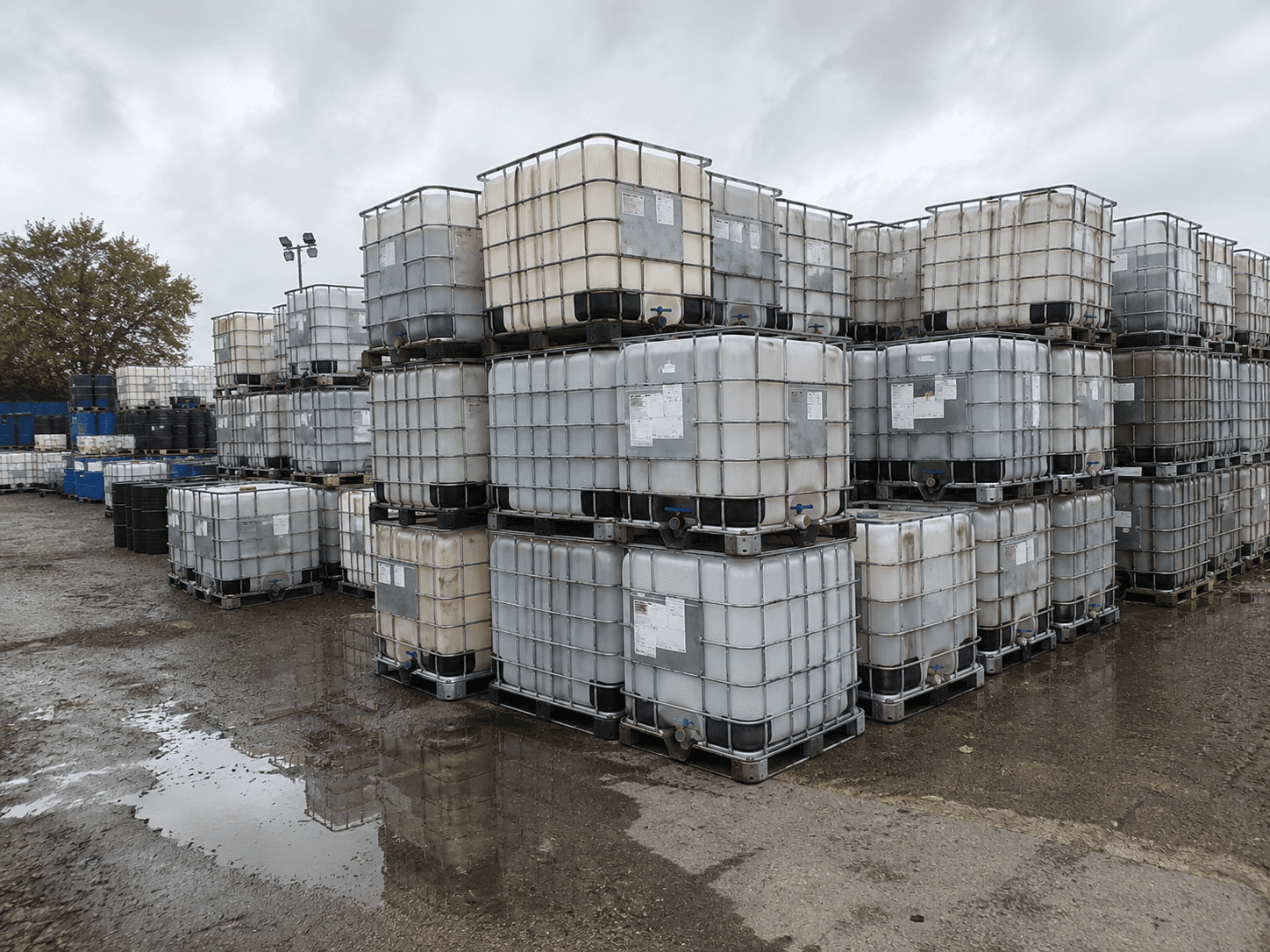
IBC totes staged at our recycling facility. Every container is disassembled and every material stream is recovered, nothing goes to landfill.
Our Zero-Landfill Commitment
Rochester IBC operates under a zero-landfill policy. Every IBC tote that enters our facility is either reused, reconditioned, or recycled into raw materials. We do not send containers to the dump. Period. This is not a marketing slogan; it is an operational standard we hold ourselves to on every single unit we process.
Since our founding, we have diverted thousands of IBC totes from landfills across Upstate New York. Each container represents approximately 200 pounds of material, including high-density polyethylene plastic, galvanized steel, and wood, all of which have established recycling markets. There is no reason for any of it to end up underground.
Material Recovery Rates Per Component
Every IBC tote is made of multiple materials, each with its own recycling pathway and recovery rate. Here is a detailed breakdown of what we recover from each component and where it goes after leaving our facility.
| Component | Material | Weight Per Unit | Recovery Rate | Recycling Destination |
|---|---|---|---|---|
| HDPE Bottle | Type 2 HDPE Plastic | 110-130 lbs | 99% | Domestic HDPE recyclers: shredded, washed, pelletized for pipe, lumber, containers |
| Steel Cage | Galvanized Tubular Steel | 70-90 lbs | 100% | Regional steel mills: melted and reformed into structural steel, automotive, appliances |
| Wood Pallet | Hardwood / Softwood | 30-45 lbs | 95% | Repaired for reuse (60%) or chipped for biomass fuel and mulch (35%) |
| Composite Pallet | Recycled Plastic Composite | 35-50 lbs | 98% | Plastic recycling stream: ground and re-molded into new composite products |
| Valve Assembly | Polypropylene + Brass/Steel | 1-3 lbs | 90% | Functional valves reused. Non-functional separated: plastic recycled, metal to scrap |
| Gaskets & Seals | EPDM / Viton Rubber | 0.5-1 lb | 85% | Rubber recovery programs: ground into crumb rubber for flooring and athletic surfaces |
Total Recovery Per IBC
A typical 275-gallon IBC weighs approximately 200 pounds when empty. Of that total weight, we recover and recycle an average of 196 pounds of material, achieving our 98% recovery rate. The remaining 2% consists of non-recoverable adhesive residue, paint, and minor consumable losses during processing.
Our IBC Recycling Process
From collection to material recovery, here is exactly what happens to every IBC tote that enters our recycling stream. Full transparency at every stage.
Collection & Intake
IBCs are picked up from your location or received at our Rochester facility. Each container is logged into our tracking system with prior contents documentation, source information, and initial condition assessment. This chain of custody begins the moment we take possession.
Inspection & Triage
Every IBC undergoes a thorough inspection. Containers that can be cleaned and returned to service are routed to our reconditioning pipeline. Units that have reached end of life, whether due to structural damage, contamination, or excessive wear, enter the recycling stream. We maximize reuse before recycling.
Disassembly & Separation
End-of-life IBCs are fully disassembled. The HDPE bottle is removed from the steel cage. Valves, gaskets, and fittings are separated. The wood or composite pallet is detached. Each material stream is collected independently for dedicated processing.
HDPE Bottle Processing
HDPE bottles are drained, rinsed, and shredded into plastic flake. The flake is washed, dried, and sorted by color and density. Clean HDPE flake is then shipped to domestic recycling processors where it is pelletized and used to manufacture new plastic products including pipe, lumber, bottles, and containers.
Steel Cage Recycling
Galvanized steel cages are cleaned, compacted, and sent to regional steel recyclers. Steel is infinitely recyclable without loss of quality. The recycled steel enters the market for new construction materials, automotive parts, appliances, and new container manufacturing.
Pallet & Component Recovery
Wood pallets are repaired and reused when possible. Damaged wood is chipped for biomass fuel or mulch. Composite pallets are recycled through dedicated plastic recycling streams. Valves, gaskets, and small fittings are sorted for reuse, metal recycling, or rubber recovery.
Documentation & Certification
Upon completion, we issue a Certificate of Recycling documenting the disposition of every container. This certificate includes the number of units processed, material weights recovered, recycling destinations, and confirmation of zero-landfill processing. This documentation supports your environmental compliance and sustainability reporting.
Environmental Impact Per Tote Recycled
Every single IBC tote we recycle generates measurable environmental benefits. Here is what one recycled container achieves compared to landfill disposal.
Material Diverted from Landfill
The total weight of an empty IBC tote, including bottle, cage, pallet, and fittings, all recovered.
CO2 Emissions Avoided
Recycling HDPE and steel uses 60-75% less energy than virgin production, avoiding significant greenhouse gases.
Energy Saved vs. Virgin Production
The combined energy savings from recycling HDPE plastic and steel instead of manufacturing from raw materials.
Water Saved vs. New Manufacturing
Virgin plastic and steel production consume massive water volumes. Recycling reduces water demand by over 80%.
EPA Compliance Deep-Dive
IBC recycling and disposal is governed by multiple federal and state regulations. Rochester IBC maintains full compliance with all applicable environmental laws and ensures your business is protected from liability throughout the process.
Federal Regulations We Follow
EPA RCRA (Resource Conservation and Recovery Act)
Governs the disposal of solid and hazardous wastes. We follow RCRA cradle-to-grave tracking for any IBC that held listed hazardous materials, ensuring proper characterization, manifesting, transport, and treatment.
DOT 49 CFR (Hazardous Materials Transportation)
All IBCs containing or previously containing hazardous materials are transported in compliance with DOT shipping requirements, including proper placarding, labeling, and documentation.
EPA TSCA (Toxic Substances Control Act)
Containers that held TSCA-regulated chemicals are processed according to specific requirements for that substance class, including PCBs, asbestos-containing materials, and certain industrial chemicals.
Clean Water Act Compliance
All rinse water and liquid residues from our recycling operations are captured, tested, and either treated on-site or sent to licensed wastewater treatment facilities. No discharge to storm drains or waterways.
State Regulations
NY DEC Part 360 (Solid Waste Management)
Our recycling operations comply with New York State Department of Environmental Conservation regulations for solid waste processing, storage, and transport.
NY DEC Part 370-374 (Hazardous Waste)
For IBCs that held NY-listed hazardous wastes, we follow state-specific manifesting, storage time limits, and treatment/disposal facility requirements that exceed federal minimums.
Multi-State Compliance
We collect IBCs from across the Northeast. Each state has specific waste transport and disposal requirements. Our operations team maintains current permits and compliance knowledge for NY, PA, OH, NJ, CT, MA, VT, and surrounding states.
Annual Reporting & Audits
We submit annual waste management reports to applicable state agencies and undergo periodic compliance audits. All records are maintained for a minimum of 5 years as required by regulation.
Hazardous Material Handling Protocols
Not every IBC can be simply rinsed and recycled. Containers that held hazardous materials, toxic chemicals, or persistent contaminants require specialized handling. Rochester IBC has the expertise and partnerships to ensure these units are processed safely and in full compliance with EPA and DEC regulations.
We work with licensed hazardous waste processors and permitted treatment facilities to manage contaminated IBCs. Residual contents are properly characterized, packaged, and transported to approved facilities. Containers are then decontaminated and recycled when possible, or safely disposed of as a last resort.
Our protocol for hazardous material IBCs follows a strict sequence: initial containment assessment, material characterization through testing, waste profile development, selection of licensed treatment facility, compliant packaging and transport, treatment or disposal at the permitted facility, and finally documentation of the complete chain of custody.
Our documentation process for contaminated units is thorough. You receive complete chain-of-custody records, waste manifests, and certificates of disposal. This protects your business from environmental liability and demonstrates regulatory compliance.
Discuss Contaminated IBCsWhat We Can Handle
- IBCs with chemical residue
- Containers with unknown prior contents
- Petroleum and solvent totes
- Agricultural chemical containers
- Paint and coating totes
- Adhesive and resin containers
- Acid and caustic solution IBCs
- Pharmaceutical waste containers
Compliance Documentation
- EPA waste manifests (Uniform Hazardous Waste Manifest)
- Certificate of disposal or destruction
- Chain of custody records
- Material characterization and lab test reports
- Licensed transporter documentation
- Facility acceptance and treatment records
- Land Disposal Restriction (LDR) notifications
- Generator certification statements
EPA Compliance Guarantee
Every contaminated IBC we process follows EPA RCRA guidelines and New York State DEC requirements. We maintain all necessary permits and work exclusively with licensed facilities. Your environmental liability is managed from pickup to final disposition.
Certificates of Recycling
Every recycling job we complete comes with an official Certificate of Recycling. This document provides auditable proof that your IBC totes were responsibly processed and that materials were recovered rather than landfilled.
These certificates are increasingly important for businesses pursuing ISO 14001 certification, submitting ESG reports, or demonstrating compliance with sustainability mandates from customers and regulators. Our certificates are formatted to meet the documentation requirements of GRI Standards, SASB, and CDP reporting.
Each certificate is assigned a unique tracking number tied to your account and the specific containers processed. Certificates can be verified by contacting our office with the reference number. We maintain copies of all certificates for a minimum of 7 years.
Request Recycling ServicesYour Certificate Includes:
The Zero Waste Journey
Our commitment to zero-landfill operations did not happen overnight. It was built through years of investment in equipment, processes, partnerships, and continuous improvement. Here is how our recycling capabilities have evolved.
Basic Material Separation
Started with manual disassembly of IBCs, separating HDPE bottles from steel cages. Partnered with local scrap metal dealers and plastic recyclers. Achieved 85% material recovery rate in the first year of operations.
Processing Equipment Investment
Installed industrial shredder for HDPE processing, hydraulic compactor for steel cages, and dedicated wash station for material decontamination. Recovery rate improved to 92% as we captured more value from each component.
Component-Level Recovery
Added valve sorting and refurbishment capability, rubber gasket recovery program, and wood pallet repair station. Every component now has a dedicated recovery pathway. Reached 96% recovery rate.
Zero-Landfill Achievement
Established partnerships with specialized recyclers for every remaining material stream including adhesive residue recovery and paint waste processing. Achieved and maintain 98% recovery rate with zero containers sent to landfill. Documentation and certification system fully digitized.
Closed-Loop Targets
Working toward 99.5% recovery rate by capturing micro-material streams. Investing in on-site HDPE pelletizing capability to process plastic flake into pellets in-house. Exploring partnerships with IBC manufacturers to create true closed-loop bottle-to-bottle recycling.
Community Recycling Programs
Rochester IBC is committed to making IBC recycling accessible beyond commercial clients. We participate in and sponsor several community-focused programs that help individuals, small businesses, and municipalities responsibly manage IBC containers.
Individual Drop-Off
Homeowners, hobby farmers, and individuals can bring single IBCs to our Rochester facility for free recycling during business hours. No appointment necessary. We accept containers in any condition. This is the easiest way to responsibly dispose of an IBC you no longer need.
Small Business Collection
Small businesses with fewer than 10 IBCs per year can schedule a collection at reduced rates. We group nearby pickups on the same route to keep costs low. Perfect for auto shops, small manufacturers, landscaping companies, and agricultural operations with occasional IBC disposal needs.
Municipal Partnerships
We partner with local municipalities and waste management districts to provide IBC recycling infrastructure for residents and businesses. This includes designated collection events, permanent drop-off locations at transfer stations, and educational materials about proper IBC disposal.
Agricultural Collection Events
We organize periodic collection events in agricultural communities where farmers can bring used IBCs (fertilizer, pesticide, water containers) for recycling at no charge. These events are coordinated with county extension offices and farm bureaus.
Industrial Park Programs
For industrial parks with multiple businesses generating IBCs, we establish shared collection points and scheduled pickups that serve the entire complex. Costs are split among participating businesses, making recycling affordable for smaller tenants.
Educational Outreach
We provide presentations and facility tours for schools, environmental organizations, and business groups interested in learning about the IBC lifecycle and circular economy principles. Understanding how containers are recycled builds community support for responsible container management.
What Happens to Each Material
Bottle Recycling
High-density polyethylene (HDPE) is one of the most recyclable plastics on earth. IBC bottles are Type 2 HDPE, the same material used in milk jugs and detergent bottles. Our recycling process transforms used IBC bottles into clean plastic flake that re-enters the manufacturing supply chain.
Second-Life Products:
- Drainage pipe and conduit
- Composite lumber and decking
- New plastic containers
- Agricultural film and sheeting
- Recycling bins and crates
Cage Recycling
Steel is the most recycled material in the world. IBC cages are made from galvanized tubular steel that retains full value in the recycling market. Unlike plastic, steel can be recycled indefinitely without degradation of properties. Every cage we recycle becomes new steel.
Second-Life Products:
- Structural steel beams
- Automotive body panels
- New container cages
- Appliances and hardware
- Rebar and construction steel
Pallet & Parts
Wood pallets are repaired and reused whenever structurally viable. Damaged wood is chipped and used as biomass fuel or landscape mulch. Composite pallets go through plastic recycling. Valves, gaskets, and fittings are sorted for reuse or material recovery.
Recovery Paths:
- Pallet repair and reuse
- Wood chip biomass fuel
- Landscape mulch
- Composite material recycling
- Brass valve recovery
The Environmental Impact of IBC Recycling
Conserve Virgin Resources
Every pound of HDPE recycled from IBC bottles replaces a pound of petroleum-derived virgin plastic. Every pound of recycled steel replaces mined iron ore. Recycling IBCs directly reduces demand for raw materials extraction.
Reduce Greenhouse Gas Emissions
Manufacturing plastic from recycled HDPE uses 75% less energy than virgin production. Recycling steel saves over 60% of energy vs. new production. The cumulative emissions savings from IBC recycling are substantial.
Prevent Landfill Pollution
IBCs in landfills can leach residual chemicals into groundwater and release microplastics into soil. Proper recycling eliminates this risk entirely and recovers valuable materials instead.
Support Circular Economy
Recycling transforms waste into feedstock. The HDPE from one IBC bottle can produce 40 feet of drainage pipe. The steel from one cage can become part of a new appliance. Materials keep circulating.
Meet Regulatory Requirements
EPA regulations require proper disposal of containers that held listed chemicals. Our documented recycling process ensures you meet these requirements with full paper trail.
Strengthen Your Brand
Consumers and B2B partners increasingly evaluate companies on environmental practices. Documented IBC recycling demonstrates concrete action beyond marketing claims.
Recycling IBCs is not just the right thing to do environmentally. It is often more cost-effective than disposal, especially when you factor in avoided tipping fees, transportation savings from our pickup services, and the potential to sell reusable containers back to us for cash. The economics and the ethics align.
Reuse First, Recycle Second
Our hierarchy is clear: reuse is always preferred over recycling. We only recycle containers that genuinely cannot be returned to service. Here is how we decide.
Reuse & Recondition
Containers that pass structural inspection and can be effectively cleaned. These enter our cleaning and reconditioning pipeline and return to active service.
- Structurally sound bottle, cage, and pallet
- Non-hazardous or cleanable prior contents
- No cracks, holes, or irreparable damage
- Valve and fittings functional or replaceable
Recycle
Containers that cannot be safely returned to service. These are disassembled and every material is sent to the appropriate recycling stream.
- Cracked, warped, or UV-degraded bottles
- Severely bent or corroded cages
- Persistent contamination after cleaning
- Exceeded maximum reuse cycles
Recycle Your IBCs Responsibly
Whether you have 5 end-of-life IBCs or 500, Rochester IBC provides the infrastructure, expertise, and documentation to recycle them properly. Free pickup available for qualifying volumes. Certificates of recycling issued for every job.
Frequently Asked Questions
What happens to an IBC tote when it is recycled?
The HDPE bottle, steel cage, and wood pallet are separated and processed: plastic is shredded and re-pelletized, steel is melted down, and pallets are reused or chipped.
Is your IBC recycling EPA-compliant?
Yes. We follow EPA-compliant processes for end-of-life and contaminated containers and can provide a certificate of recycling.
Do you recycle contaminated or hazmat IBC totes?
We handle contaminated units through compliant disposal channels. Tell us the prior contents so we can route each tote safely.
Can I get documentation for my sustainability reporting?
Yes. We provide recycling certificates and diversion documentation to support your ESG and zero-landfill reporting.
Is there a cost to recycle IBC totes?
Costs depend on quantity, condition, and contamination. Many reusable units have resale value that offsets or eliminates recycling fees.